
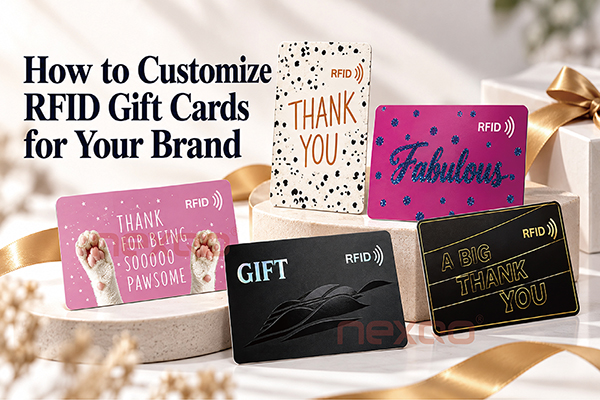
Learn how to customize RFID gift cards with the right materials, printing, personalization, and functional options for retail brands, hotels, restaurants, loyalty programs, and promotional campaigns.
Introduction
A gift card is more than a payment or promotional tool.
For many brands, it is also a physical representation of the customer experience.
Customers may purchase it, receive it as a gift, use it in-store, or keep it as part of their relationship with the brand.
Custom RFID gift cards combine:
- brand design
- physical card presentation
- contactless identification options
- personalized information
Compared with traditional gift cards, RFID or NFC-enabled gift cards can provide additional interaction possibilities when integrated with compatible systems.
The final card design depends on:
- brand identity
- card material
- printing requirements
- functional requirements
- existing gift card or POS environment
The goal is not to add every available feature.
The goal is to create a gift card that is visually attractive, practical, and suitable for the intended application.
Quick Answer: What Can Be Customized on RFID Gift Cards?
Custom RFID gift cards can be customized through:
| Customization Area | Options |
| Card Material | PVC, PET, BioPVC, BioPaper, Wood |
| Brand Design | Logo, colors, artwork, graphics |
| Printing | Full-color printing, variable printing |
| Finishing | Matte, gloss, satin, Spot UV, foil stamping |
| RFID Function | RFID/NFC chip, encoding |
| Identification Features | QR code, barcode, serial number |
| Magnetic Features | Magnetic stripe when required |
| Personalization | Card number, unique data, variable information |
The right combination depends on:
- where the card will be used
- how customers interact with it
- existing card systems
- brand positioning
- production requirements
Where Are Custom RFID Gift Cards Used?
RFID gift cards can be customized for different industries and brand applications.
Retail Gift Cards
Common applications include:
- fashion brands
- cosmetics stores
- department stores
- specialty retailers
Important considerations:
- brand appearance
- card durability
- customer experience
- barcode or card-number requirements
Hotel and Hospitality Gift Cards
Suitable for:
- hotels
- resorts
- restaurants
- hospitality programs
Common customization needs:
- premium design
- brand logo
- elegant materials
- personalized gift messaging
Promotional and Campaign Cards
Brands may use custom RFID gift cards for:
- seasonal campaigns
- customer rewards
- loyalty programs
- special promotions
These projects often focus on:
- unique artwork
- limited editions
- variable numbering
- campaign-specific designs
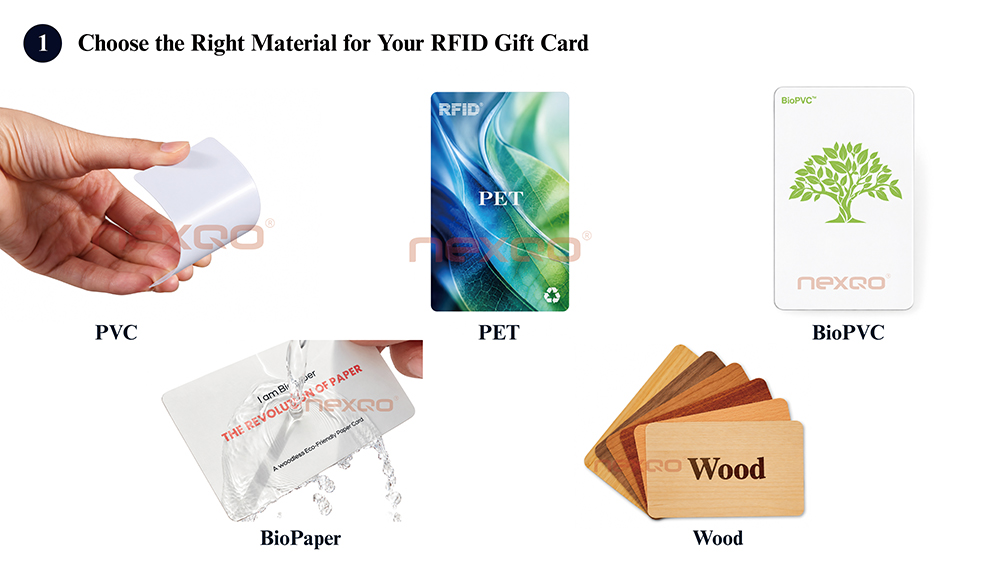
1. Choose the Right Material for Your RFID Gift Card
Material affects:
- appearance
- durability
- printing quality
- brand perception
Different projects require different card structures.
PVC RFID Gift Cards
PVC is the most common option for custom gift cards.
Suitable for:
- retail gift cards
- promotional cards
- loyalty cards
- general branded cards
Advantages:
- excellent printing quality
- stable card structure
- wide customization options
- cost-effective production
PVC provides a practical balance between appearance and production flexibility.
PET RFID Gift Cards
PET may be considered when stronger durability is required.
Suitable for:
- frequently handled cards
- long-term use
- applications requiring stronger material performance
Advantages:
- durable structure
- good dimensional stability
- suitable for repeated handling
BioPVC and BioPaper Gift Cards
These materials may be selected by brands with sustainability goals.
Suitable for:
- eco-conscious campaigns
- sustainable packaging programs
- brands with material preferences
Environmental claims should always match the actual material specification and certification requirements.
Wood RFID Gift Cards
Wood cards provide a natural appearance and distinctive texture.
Suitable for:
- premium gift programs
- luxury brands
- special edition cards
- creative campaigns
The material itself becomes part of the customer experience.
2. Customize the Card Design and Brand Identity
The visual design is one of the most important parts of a gift card.
Common design elements include:
- brand logo
- company colors
- seasonal graphics
- campaign artwork
- product images
- gift messages
A successful gift card design should balance:
- brand recognition
- readability
- customer appeal
- production feasibility
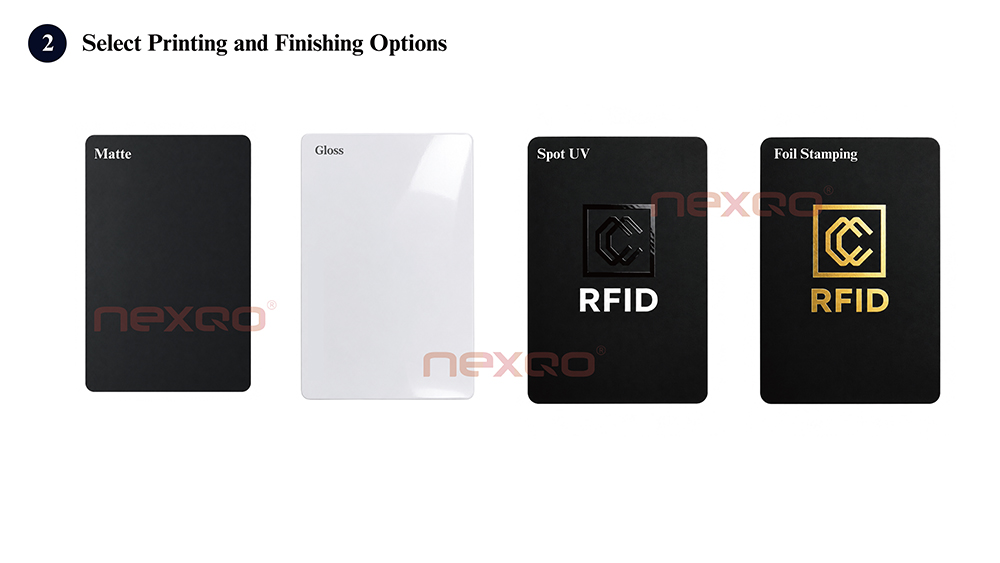
3. Select Printing and Finishing Options
Printing and finishing help create different visual effects.
Full-Color Printing
Suitable for:
- brand graphics
- illustrations
- campaign artwork
- promotional designs
Matte Finish
Creates:
- clean appearance
- professional style
- reduced reflection
Gloss Finish
Provides:
- brighter colors
- smooth surface
- stronger visual impact
Spot UV
Used to highlight:
- logos
- selected graphics
- design details
Foil Stamping
Used for:
- brand names
- logos
- premium decorative elements
For detailed comparisons between different foil processes, finishing techniques should be selected according to the intended visual effect.
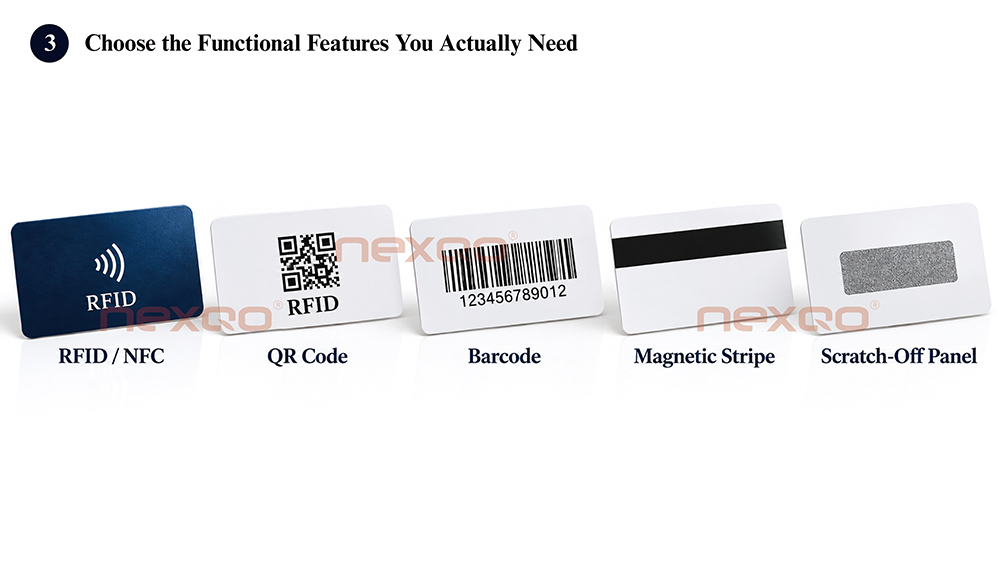
4. Choose the Functional Features You Actually Need
Not every gift card requires every available feature.
Common options include:
| Feature | Possible Application |
| RFID/NFC | Contactless identification or interaction |
| QR Code | Digital access or information link |
| Barcode | Scannable identification |
| Magnetic Stripe | Compatibility with existing stripe-based systems |
| Card Number | Individual card identification |
| Serial Number | Tracking and identification |
| Scratch-Off Panel | Concealed code or PIN |
The correct combination depends on the existing gift card environment.
RFID/NFC Does Not Replace the Gift Card System
This distinction is important.
The RFID or NFC component provides:
- card identification
- contactless interaction
- encoded information
However:
- activation
- balance management
- redemption
- transaction records
are normally handled by the customer’s gift card platform, POS system, or software provider.
NEXQO provides the physical RFID/NFC gift card hardware, including printing, customization, and encoding.
5. Decide How Variable Information Will Be Added
Many gift card projects require unique information.
Examples include:
- card numbers
- serial numbers
- unique QR codes
- individual URLs
- customer-specific information
There are different production approaches.
Factory Personalization
Suitable for:
- large confirmed batches
- pre-defined card data
- ready-to-use delivery
Advantages:
- consistent production quality
- controlled data matching
- efficient for large quantities
Local Personalization
Suitable for:
- frequently changing information
- replacement cards
- businesses managing their own issuance process
The choice depends on how the brand manages its gift card operation.
6. RFID/NFC Chip and System Compatibility
Before production, confirm:
- RFID or NFC requirement
- chip type
- frequency
- reader compatibility
- encoding requirements
The correct chip depends on:
- existing system
- required function
- data requirements
A higher-specification chip is not always necessary if the application only requires basic identification or digital access.
7. What Buyers Should Confirm Before Ordering RFID Gift Cards
Before mass production, confirm:
Card Design
- artwork
- colors
- logo placement
- finishing requirements
Material
- PVC
- PET
- BioPVC
- BioPaper
- Wood
Functional Features
- RFID/NFC
- QR code
- barcode
- magnetic stripe
- serial number
Data Requirements
- variable data
- card numbering
- encoding information
Production Details
- quantity
- sample approval
- packaging
- delivery schedule
Confirming these details early helps ensure the visual design and functional requirements work together.
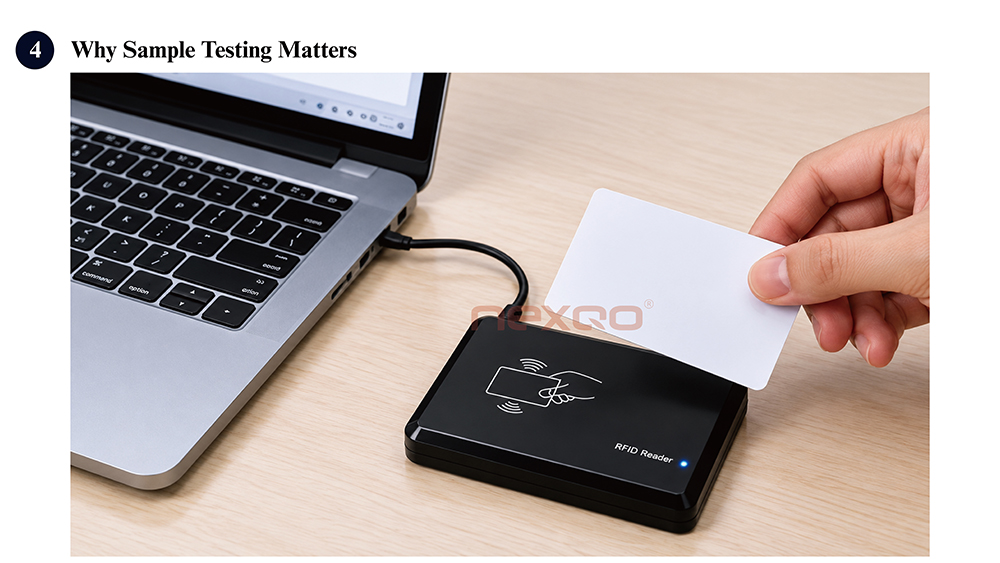
Why Sample Testing Matters
Before mass production, physical samples should be evaluated.
Testing can confirm:
- card appearance
- printing quality
- RFID/NFC performance
- QR readability
- barcode readability
- magnetic stripe compatibility
- personalization accuracy
This is especially important when combining:
- special materials
- premium finishes
- RFID/NFC functions
- variable data
What NEXQO Provides
NEXQO manufactures custom RFID and NFC gift cards.
Available options include:
- PVC RFID Gift Cards
- PET RFID Gift Cards
- BioPVC Gift Cards
- BioPaper Gift Cards
- Wood Gift Cards
- NFC Gift Cards
Customization services include:
- full-color printing
- Pantone color matching
- Spot UV
- foil stamping
- matte, gloss, satin finishes
- QR code printing
- barcode printing
- serial numbering
- variable data
- RFID/NFC encoding
NEXQO provides gift card hardware manufacturing.
We do not provide:
- gift card management platforms
- POS systems
- balance management software
- customer loyalty software
These functions are normally provided by the customer or their software/system partners.
FAQ
What materials are available for custom RFID gift cards?
Common options include PVC, PET, BioPVC, BioPaper, and Wood depending on the brand requirements and application.
Can RFID gift cards include QR codes and barcodes?
Yes. QR codes, barcodes, serial numbers, and other variable information can be printed according to project requirements.
Can RFID gift cards also have magnetic stripes?
Yes. RFID/NFC can be combined with magnetic stripes when compatibility with existing systems is required.
Does the RFID chip manage the gift card balance?
Not necessarily. The RFID/NFC component provides identification or contactless interaction. Balance management and redemption depend on the customer’s gift card system.
Which material is best for custom gift cards?
There is no single best material. PVC is widely used, PET offers durability, while BioPVC, BioPaper, and Wood provide different brand presentation options.
Can gift cards have different designs in the same order?
Yes. Different artwork, serial numbers, and variable data can be produced according to project requirements.
Conclusion
Custom RFID gift cards combine physical brand presentation with contactless functionality.
The best gift card design depends on selecting the right combination of:
- material
- artwork
- printing
- finishing
- RFID/NFC features
- personalization requirements
A successful gift card project does not require every available option.
The strongest results come from choosing the features that support the brand, customer experience, and actual application.
CTA
Looking for custom RFID gift cards?
NEXQO manufactures RFID and NFC gift cards with customized materials, printing, finishing, QR codes, barcodes, serial numbering, variable data, and encoding options.
Share your gift card application, material preference, design requirements, functional needs, quantity, and system requirements with our team. We can recommend suitable card structures and provide samples for evaluation before production.