
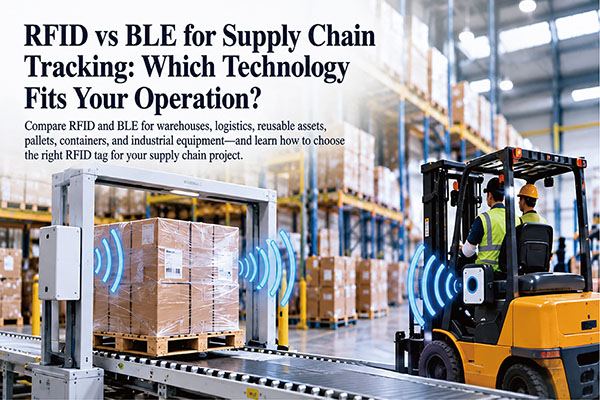
Compare RFID and BLE for warehouses, logistics, reusable assets, pallets, containers, and industrial equipment—and learn how to choose the right RFID tag for your supply chain project.
Introduction
RFID and Bluetooth Low Energy, or BLE, are both used in supply chain and warehouse projects, but they solve different problems.
A project may need to identify:
- cartons
- pallets
- returnable containers
- tools
- forklifts
- warehouse equipment
- high-value reusable assets
The right technology depends on what needs to be tracked and how often its location or identity needs to be updated.
A practical starting point is:
- Choose passive RFIDfor high-volume identification, inventory counting, pallet and carton tracking, and warehouse checkpoints.
- Consider BLEwhen powered devices or reusable assets require ongoing signal broadcasts and location updates.
- Use RFID and BLE togetherwhen goods and equipment require different tracking methods.
For NEXQO customers, the most important product question is usually:
Which RFID tag structure is suitable for the item, surface, environment, and reader setup?
Quick Answer: RFID or BLE?
| Tracking Requirement | Practical Starting Point |
| Carton and pallet identification | Passive UHF RFID |
| Warehouse receiving and shipping | Passive UHF RFID |
| Bulk inventory counting | Passive UHF RFID |
| Low-cost disposable item labels | Passive RFID labels |
| Metal reusable containers | On-metal RFID tags |
| Tools and industrial equipment | Durable RFID hard tags |
| Ongoing location signals from reusable assets | BLE |
| Goods plus reusable equipment | RFID and BLE may be combined |
RFID and BLE are not direct replacements for each other.
Passive RFID is generally better suited to identifying large numbers of tagged items at defined reading points. BLE is more commonly considered when powered tags need to broadcast signals over time.
What Is the Main Difference Between RFID and BLE?
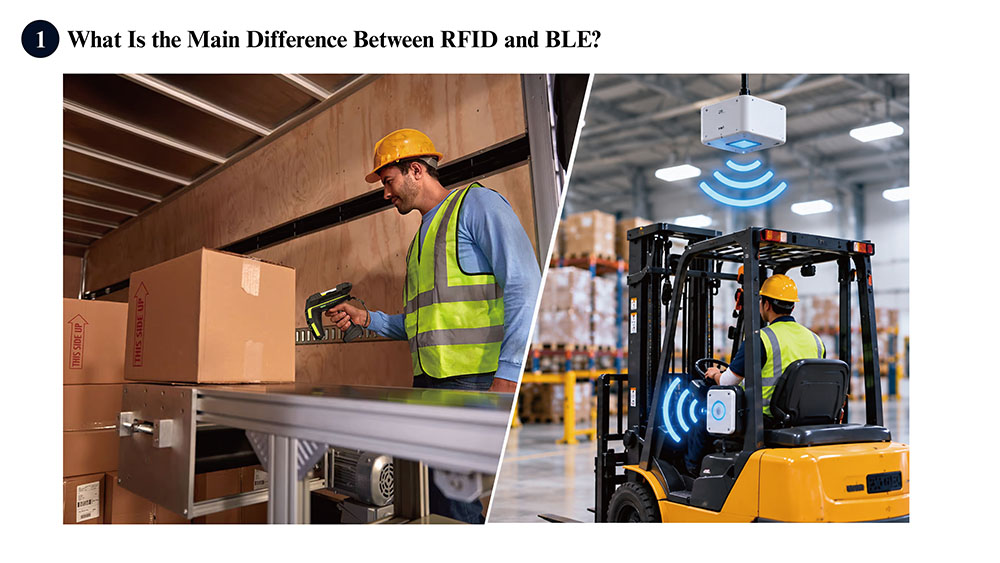
For most warehouse and logistics projects, the main difference is how the tag communicates.
Passive RFID
A passive RFID tag normally receives energy from a compatible RFID reader.
It is commonly used for:
- item identification
- pallet and carton tracking
- receiving and shipping
- inventory counting
- warehouse checkpoints
- reusable container identification
Passive RFID tags normally do not require batteries, which makes them practical for large-volume deployments.
BLE
A BLE tag normally contains a battery and periodically broadcasts a signal.
It is commonly considered for:
- reusable equipment
- high-value assets
- indoor location projects
- tools
- forklifts
- powered or maintainable devices
BLE projects normally require BLE tags, gateways or mobile devices, and location or asset-management software.
NEXQO focuses on RFID hardware products and does not provide BLE tags, BLE gateways, indoor positioning platforms, or supply chain software.
RFID vs BLE: Practical Comparison
| Feature | Passive RFID | BLE |
| Battery | Usually not required | Normally required |
| Best suited to | Goods, cartons, pallets, inventory | Reusable equipment and high-value assets |
| Identification method | Read by RFID reader | Signal detected by gateway or mobile device |
| Bulk item identification | Strong | Not the main use |
| Continuous signal broadcasting | No | Yes |
| Disposable tag options | Strong | Usually less practical |
| Maintenance | Low for passive labels | Battery management required |
| Typical product cost | Lower for high-volume labels | Higher per device |
| Main hardware | RFID labels or tags | Powered BLE beacons or tags |
Actual performance depends on tag design, reader placement, gateways, software, environment, and deployment configuration.
When Is RFID Better for Supply Chain Tracking?
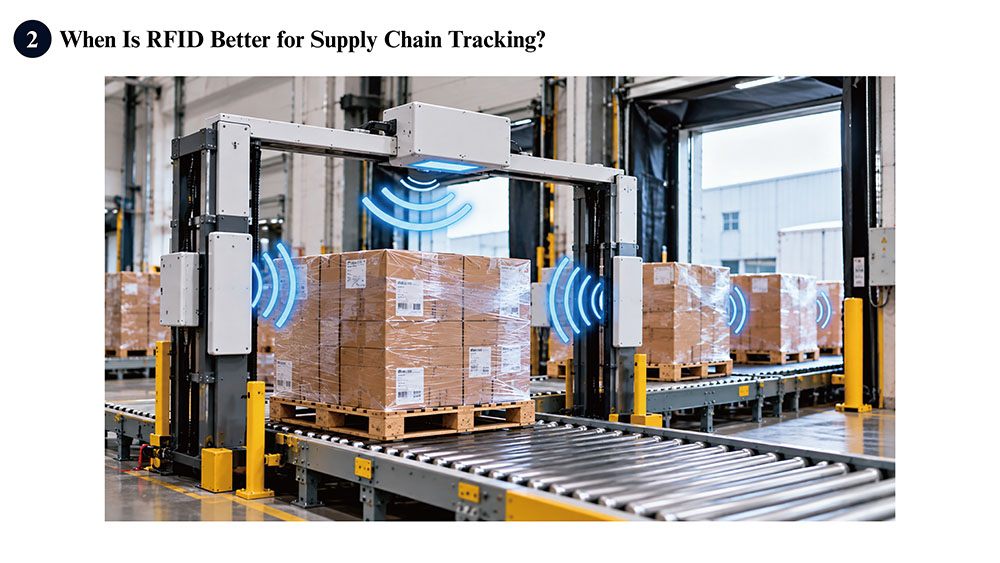
Passive RFID is usually the stronger choice when the project involves a large number of physical goods.
Typical applications include:
- warehouse receiving
- shipping verification
- inventory counting
- pallet identification
- carton tracking
- retail logistics
- distribution centers
- reusable transport items
- industrial asset identification
The main advantage is not “real-time tracking” in the BLE sense.
The advantage is the ability to identify tagged goods without individually scanning every barcode.
For many warehouse projects, RFID is used at:
- dock doors
- conveyor points
- storage areas
- packing stations
- handheld inventory checks
The final result still depends on the reader system and warehouse software.
Which RFID Tags Are Used for Cartons and Pallets?
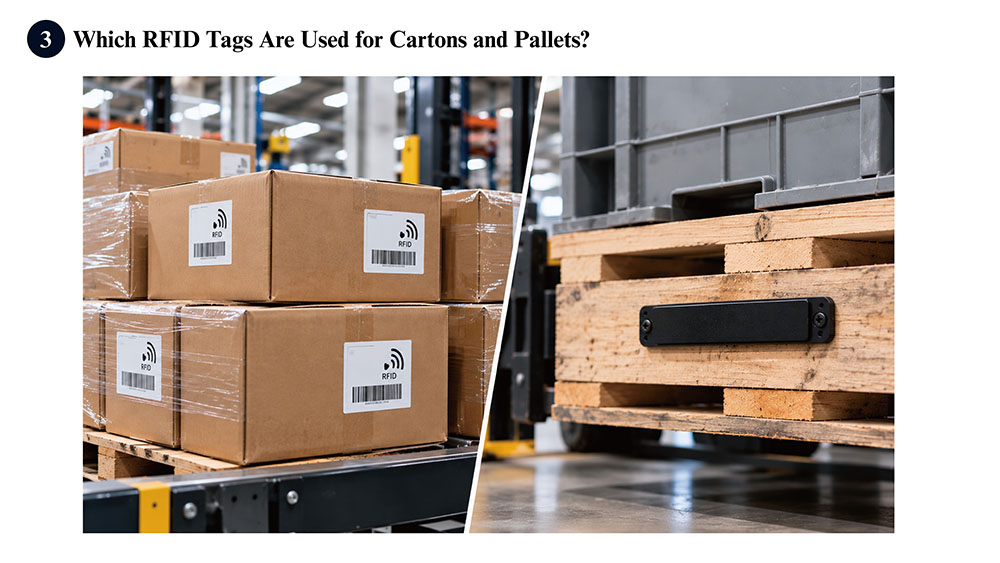
UHF RFID Labels for Cartons
Standard UHF RFID labels are commonly used for:
- cardboard cartons
- paper packaging
- plastic packaging
- shipping boxes
- retail cases
Available options may include:
- paper UHF RFID labels
- PET UHF labels
- thermal printable RFID labels
- pre-printed RFID labels
- labels with barcodes and serial numbers
- encoded EPC data
For carton applications, buyers should confirm:
- carton material
- product inside the carton
- label position
- reader direction
- required label size
- printing method
- encoding data
Liquids, metal products, and dense materials inside the carton may affect RFID performance.
RFID Tags for Pallets
Pallet tracking may use:
- durable RFID labels
- hard RFID tags
- nail or screw-mounted tags
- cable-tie RFID tags
- embedded RFID tags
- on-metal tags for metal pallets
The correct product depends on whether the pallet is:
- wooden
- plastic
- metal
- disposable
- returnable
- exposed to outdoor or industrial conditions
A paper shipping label and a reusable pallet tag should not use the same product structure.
Which RFID Tags Are Suitable for Reusable Containers?
Reusable containers, totes, bins, and transport items usually require a more durable RFID product.
Typical options include:
- durable PET RFID labels
- ABS RFID hard tags
- FR4 RFID tags
- flexible on-metal labels
- cable-tie RFID tags
- screw-mounted RFID tags
Plastic Containers
For flat plastic surfaces, a durable RFID label may be sufficient.
However, the buyer should still confirm:
- plastic type
- surface texture
- cleaning process
- expected lifespan
- available installation area
Metal Containers
Metal containers usually require:
- on-metal RFID labels
- on-metal hard tags
- specially designed mounting structures
A standard UHF label may not read reliably when attached directly to metal.
Foldable or Curved Containers
Flexible RFID tags or cable-tie structures may be more practical when the surface is:
- curved
- ribbed
- textured
- difficult to bond with adhesive
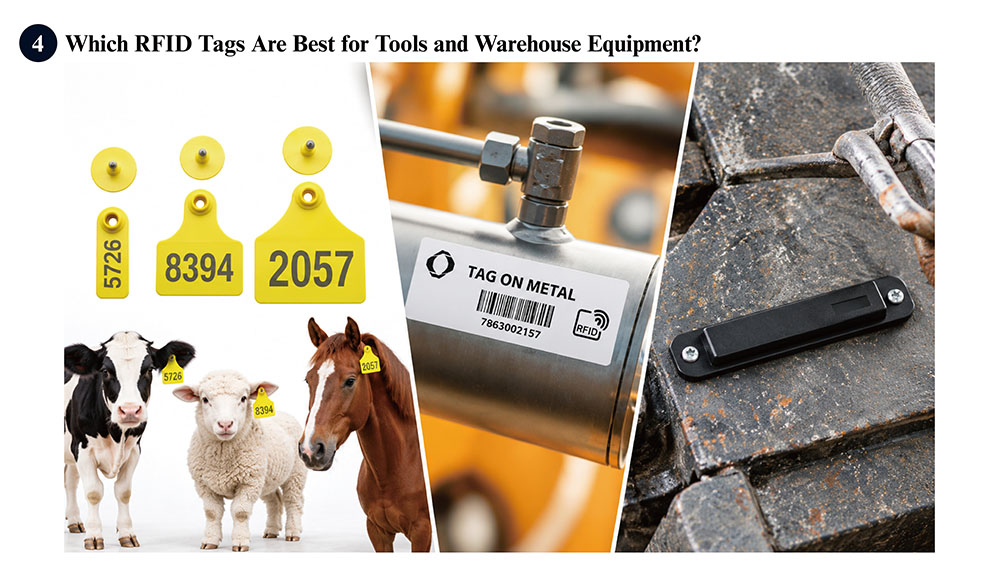
Which RFID Tags Are Best for Tools and Warehouse Equipment?
Tools and industrial equipment may require more durable tags than cartons and pallets.
Typical products include:
- small on-metal RFID tags
- ABS hard tags
- FR4 RFID tags
- cable-tie RFID tags
- high-strength adhesive tags
- custom mounting tags
Possible applications include:
- maintenance tools
- forklifts
- warehouse equipment
- racks
- carts
- returnable fixtures
- industrial containers
For tools and equipment, buyers should consider:
- metal or non-metal surface
- impact
- vibration
- oil or chemical exposure
- cleaning
- outdoor use
- available mounting space
- screw, rivet, adhesive, or cable-tie installation
The smallest tag is not always the best tag. Reducing tag size may also reduce antenna area and affect reading performance.
When Does BLE Make More Sense?
BLE may be more suitable when the project requires powered tags to broadcast signals regularly.
Typical examples include:
- locating forklifts inside a warehouse
- monitoring reusable equipment
- finding high-value tools
- locating containers inside a facility
- tracking powered devices
BLE may offer ongoing location updates when connected to the appropriate gateway and positioning system.
However, buyers should also consider:
- battery life
- battery replacement
- tag maintenance
- gateway coverage
- installation cost
- software and positioning logic
- long-term device management
BLE is usually less suitable for attaching a powered tag to every low-cost carton or disposable package.
Can RFID and BLE Be Used Together?
Yes.
A supply chain project may use:
- passive RFID labels for cartons and pallets
- durable RFID tags for reusable containers
- BLE tags for forklifts and high-value equipment
For example:
- RFID can identify goods when they enter or leave a warehouse.
- BLE can provide ongoing signals from reusable equipment inside the facility.
The two technologies may complement each other because they track different types of objects.
NEXQO supplies the RFID hardware side of these projects. BLE devices, gateways, positioning software, warehouse software, and system integration are provided by the customer or its technology partners.
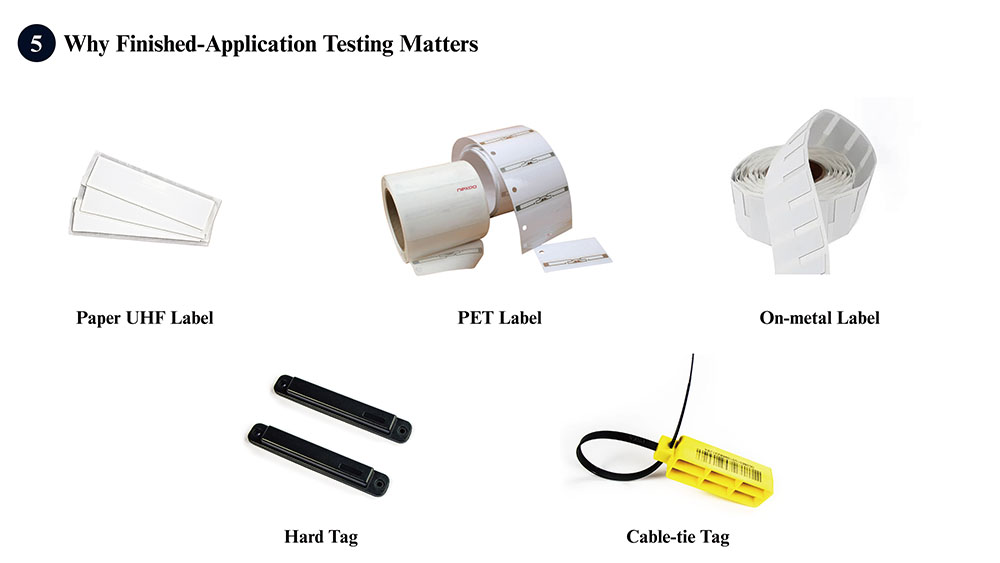
Which RFID Tag Should You Choose?
Standard UHF RFID Labels
Best for:
- cartons
- paper packaging
- plastic packaging
- shipping labels
- disposable logistics applications
Thermal Printable RFID Labels
Best for:
- variable shipping information
- barcode and RFID combination labels
- warehouse printing
- on-demand label production
Printer model, label pitch, antenna position, and encoding compatibility should be confirmed before production.
Durable PET RFID Labels
Best for:
- reusable plastic bins
- warehouse assets
- longer service life
- moisture-resistant applications
On-Metal RFID Labels
Best for:
- metal containers
- equipment
- racks
- metal pallets
- cabinets
RFID Hard Tags
Best for:
- reusable assets
- industrial tools
- harsh environments
- long-term installation
- screw or rivet mounting
Cable-Tie RFID Tags
Best for:
- pipes
- cages
- irregular equipment
- assets without a suitable flat adhesive area
RFID Tag Selection Guide
| Asset or Surface | Recommended RFID Product |
| Cardboard carton | Paper or thermal UHF RFID label |
| Plastic tote | Durable PET RFID label |
| Wooden pallet | Durable label or hard RFID tag |
| Plastic pallet | Hard RFID tag or durable label |
| Metal pallet | On-metal RFID tag |
| Metal container | On-metal label or hard tag |
| Warehouse tool | Small on-metal or hard RFID tag |
| Pipe or cage | Cable-tie RFID tag |
| Disposable package | Low-cost RFID label |
| Outdoor reusable asset | Weather-resistant hard RFID tag |
The table provides a starting point. Samples should still be tested on the actual asset.
What Buyers Should Confirm Before Requesting a Quotation
Item Information
Provide:
- item type
- item material
- product contents
- metal or non-metal surface
- available tag area
- disposable or reusable use
- indoor or outdoor conditions
RFID Requirements
Confirm:
- reader frequency
- chip requirement
- required read method
- fixed or handheld reader
- single or bulk identification
- memory requirement
- encoding data
Product Requirements
Confirm:
- label or hard tag
- dimensions
- material
- adhesive
- mounting method
- blank or printed
- barcode
- QR code
- serial number
- EPC encoding
Project Information
Provide:
- quantity
- number of tag types
- printer model, if applicable
- delivery schedule
- sample requirement
- testing method
The phrase “supply chain RFID tag” is not enough for an accurate product recommendation. The physical item and installation condition are essential.
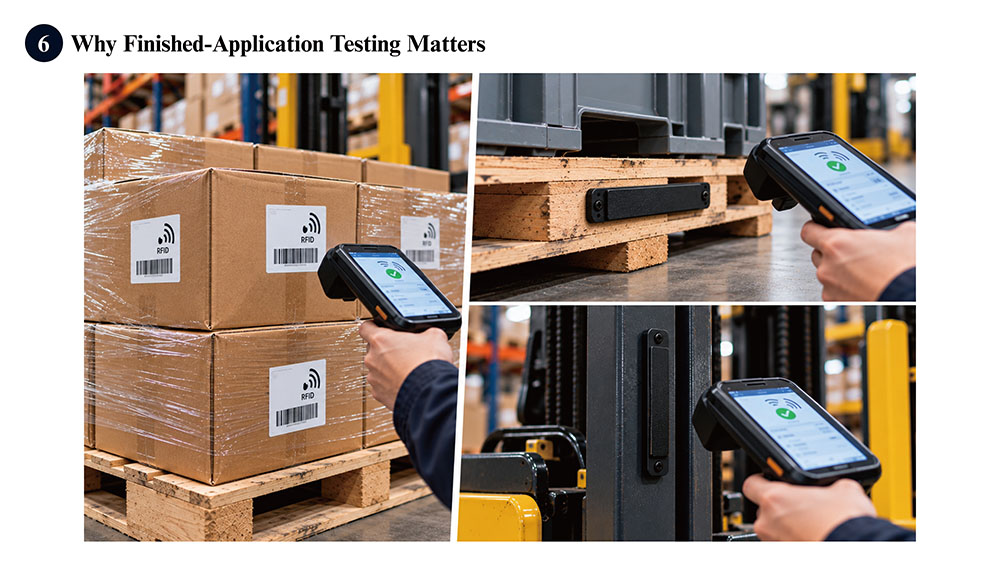
Why Finished-Application Testing Matters
Testing an RFID tag in free air is not enough.
The final product should be tested:
- on the actual carton, pallet, container, or equipment
- in the real mounting position
- with the actual reader
- at the intended checkpoint
- with nearby goods and materials
Testing should confirm:
- reader compatibility
- read performance
- tag orientation
- adhesive or mounting strength
- printing accuracy
- encoding accuracy
- barcode readability
- durability
For cartons containing metal or liquid, and for on-metal applications, actual product testing is especially important.
What NEXQO Provides
NEXQO focuses on RFID hardware products.
We can provide:
- UHF RFID labels
- thermal printable RFID labels
- PET RFID asset labels
- pallet RFID tags
- on-metal RFID labels
- ABS and FR4 hard RFID tags
- cable-tie RFID tags
- custom RFID inlays
- barcode and QR-code printing
- serial numbering
- EPC encoding
- variable data
- sample development
NEXQO does not provide:
- BLE tags or beacons
- BLE gateways
- indoor positioning software
- warehouse-management software
- supply chain platforms
- real-time location software
- system integration
These functions are normally supplied by the customer, a software company, or a system integrator.
Our role is to help match the physical RFID tag with the item, surface, reader, printing, encoding, and operating environment.
FAQ
Is BLE better than RFID for supply chain tracking?
Not necessarily. BLE is more commonly considered for powered reusable assets that need ongoing signal broadcasts. Passive RFID is generally more practical for high-volume goods, cartons, pallets, and inventory identification.
Can RFID provide real-time tracking?
Passive RFID does not normally provide continuous location by itself. It records identification when a tag is read at a checkpoint or by a handheld reader. Real-time visibility depends on the reader network, software, and system design.
Can RFID and BLE be used together?
Yes. A project may use RFID for goods and inventory, while BLE is used for forklifts, tools, or reusable equipment.
Which RFID tag is best for cardboard cartons?
Paper or thermal printable UHF RFID labels are commonly used, but the product inside the carton and the reader setup should be tested.
Which RFID tag works on metal containers?
On-metal RFID labels or hard tags should normally be considered. Standard RFID labels may not perform reliably when attached directly to metal.
Are RFID tags suitable for reusable pallets?
Yes. Durable labels, hard tags, embedded tags, or on-metal tags may be used depending on whether the pallet is wood, plastic, or metal.
Does NEXQO provide BLE or warehouse-tracking software?
No. NEXQO supplies RFID hardware, printing, encoding, and samples. BLE devices, warehouse software, dashboards, positioning, and system integration are provided by the customer or its technology partners.
Conclusion
RFID and BLE solve different supply chain tracking requirements.
- Passive RFID is generally suitable for cartons, pallets, goods, inventory, and checkpoint identification.
- BLE is more suitable for powered reusable assets requiring ongoing signal broadcasts.
- Some operations may use both technologies for different asset groups.
For customers selecting RFID, the next step is choosing the correct product:
- standard RFID label
- thermal printable RFID label
- durable PET label
- on-metal RFID tag
- hard RFID tag
- cable-tie RFID tag
The correct tag should match the item material, installation surface, reader setup, service life, printing, encoding, and operating environment.
CTA
Looking for RFID tags for warehouse, logistics, or supply chain applications?
NEXQO supplies UHF RFID labels, thermal printable RFID labels, pallet tags, durable RFID asset labels, on-metal RFID tags, hard tags, and cable-tie RFID tags.
Share your item type, surface material, reader requirement, tag size, mounting method, printing, encoding, quantity, and test conditions with our team. We can recommend suitable RFID products and prepare samples for evaluation before production.