
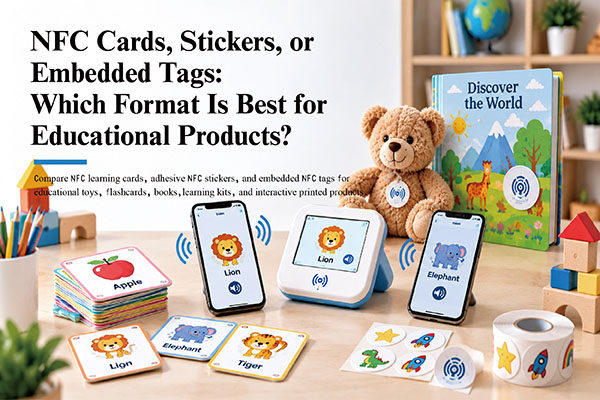
Compare NFC learning cards, adhesive NFC stickers, and embedded NFC tags for educational toys, flashcards, books, learning kits, and interactive printed products.
Introduction
When adding NFC to an educational product, one of the first product decisions is the NFC format.
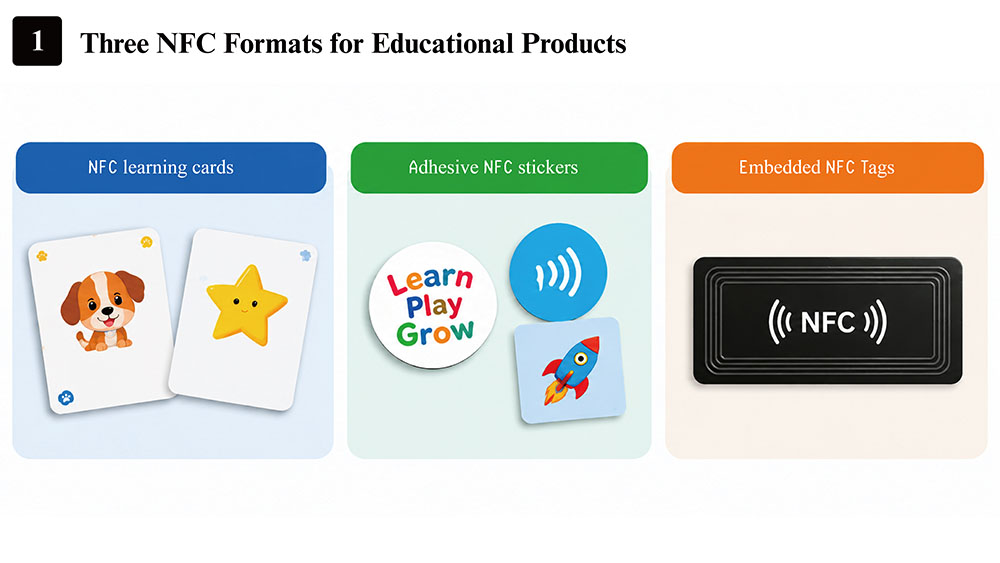
Should the project use:
- NFC learning cards
- adhesive NFC stickers
- or NFC tags embedded inside the product?
The answer usually depends on the physical product, not only the digital content.
A reusable flashcard set, a plastic educational toy, and an interactive book have different requirements for:
- durability
- antenna size
- material compatibility
- product appearance
- manufacturing process
- replacement and repair
- user tapping position
A practical starting point is:
- Choose NFC cardsfor reusable flashcards and structured learning sets.
- Choose NFC stickerswhen NFC needs to be added to an existing toy, kit, package, or printed product.
- Choose embedded NFC tagswhen the tag should be hidden inside a card, book, toy, or molded product.
The right product should be selected together with the NFC chip, antenna size, material, printing, adhesive, and final assembly method.
Quick Product Selection Guide
| Educational Product | Recommended NFC Format |
| Language learning flashcards | NFC cards |
| Reusable classroom learning sets | NFC cards |
| Educational game cards | NFC cards |
| Existing toys or learning kits | NFC stickers |
| Product packaging | NFC stickers |
| DIY educational projects | NFC stickers |
| Laminated learning boards | Embedded NFC tags |
| Interactive books | Embedded NFC tags |
| Plastic toy housings | Embedded NFC tags |
| Products requiring hidden NFC | Embedded NFC tags |
This is a starting point. The final choice should also consider product material, expected tapping position, reader type, and production method.
1. NFC Learning Cards
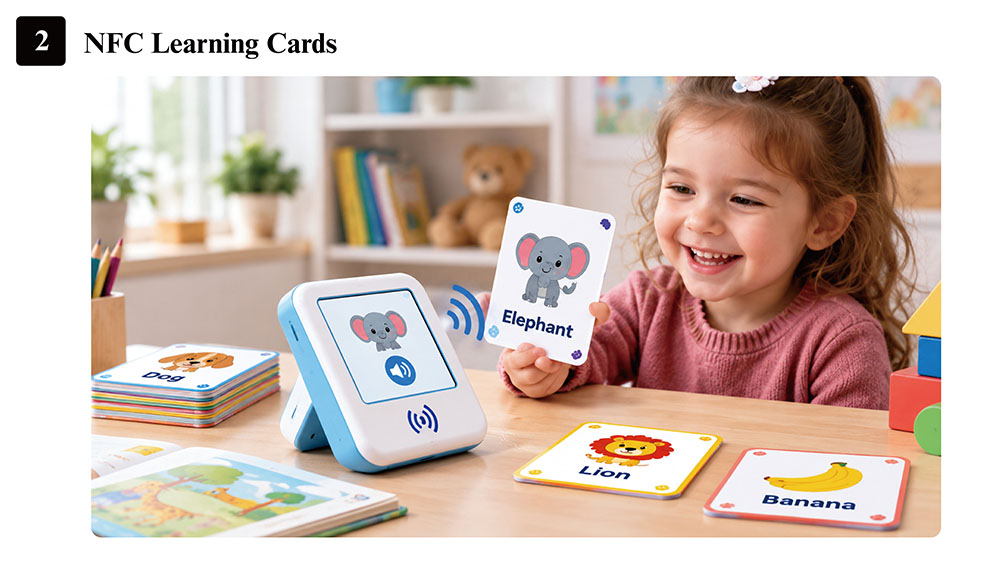
NFC cards are commonly selected for educational products that are handled, sorted, tapped, and reused frequently.
Typical applications
- language learning cards
- phonics cards
- vocabulary flashcards
- mathematics learning cards
- classroom activity sets
- educational game cards
- interactive training cards
- children’s learning systems
Why choose NFC cards?
NFC cards offer:
- a consistent size and structure
- good protection for the NFC inlay
- large printable surfaces
- easy organization into complete learning sets
- support for variable artwork and coding
- better durability for repeated handling
They are especially practical when every learning item needs its own artwork, NFC identity, or digital response.
Available card materials
Depending on the project, NFC learning cards may be produced in:
- PVC
- PET
- PETG
- ABS
- BioPVC
- paper-based laminated structures
The material should be selected according to:
- target age group
- card thickness
- bending requirements
- printing quality
- expected product life
- sustainability requirements
- product safety and compliance requirements
Card customization options
NFC learning cards can include:
- full-color printing
- different artwork on every card
- numbers or letters
- QR codes
- barcodes
- serial numbers
- UID matching
- chip encoding
- matte or glossy surfaces
- rounded corners
- custom sizes and shapes
For learning sets containing many different designs, artwork, encoding data, and card sequence should be matched carefully during production.
2. Adhesive NFC Stickers
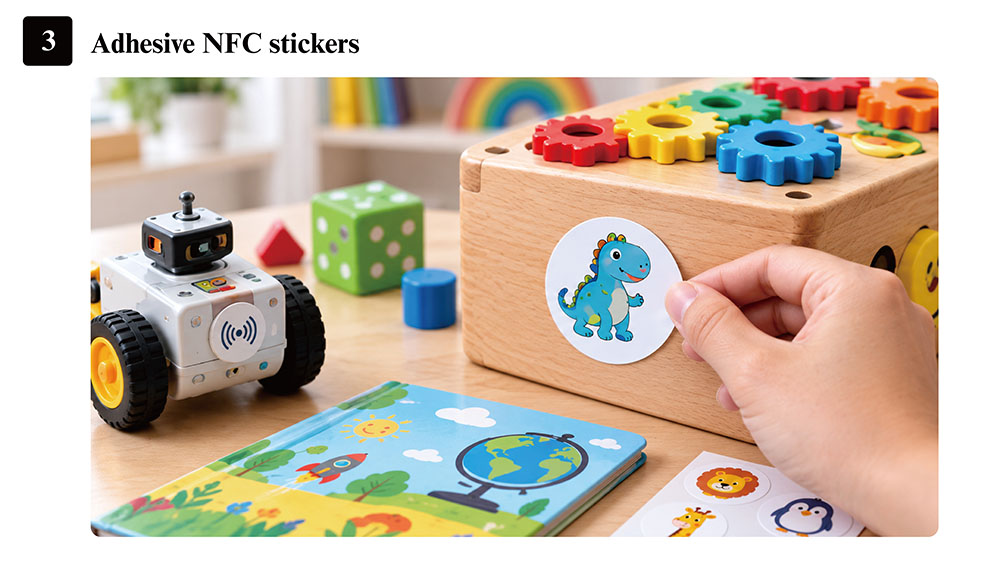
NFC stickers are suitable when NFC functionality needs to be added to an existing product without redesigning the entire product structure.
Typical applications
- educational toys
- STEM kits
- learning boards
- product packaging
- classroom equipment
- DIY learning products
- replacement or upgrade projects
Why choose NFC stickers?
NFC stickers offer:
- flexible sizes and shapes
- simple product integration
- lower structural change requirements
- different printing and surface options
- easier application during or after assembly
- suitability for both small and large production runs
They are often the most practical option when the product already exists and only needs an NFC interaction point.
Sticker construction options
An NFC sticker may include:
- printed paper surface
- printed PET surface
- PVC surface
- transparent PET
- tamper-evident construction
- custom die-cut shape
- permanent adhesive
- removable adhesive
- foam adhesive
- protective surface lamination
The adhesive should be selected according to the actual product surface.
A sticker used on a smooth plastic toy may require a different adhesive from one used on:
- coated paper
- cardboard
- fabric
- wood
- curved plastic
- textured surfaces
What buyers should confirm
Before ordering NFC stickers, confirm:
- application surface
- flat or curved installation
- indoor or outdoor use
- expected product lifespan
- sticker size
- printing requirements
- adhesive type
- whether the sticker must be removable
- whether the tag needs tamper evidence
- whether the product contains metal
Standard NFC stickers may not perform normally when placed directly on metal. Projects involving metal surfaces generally require an NFC anti-metal structure.
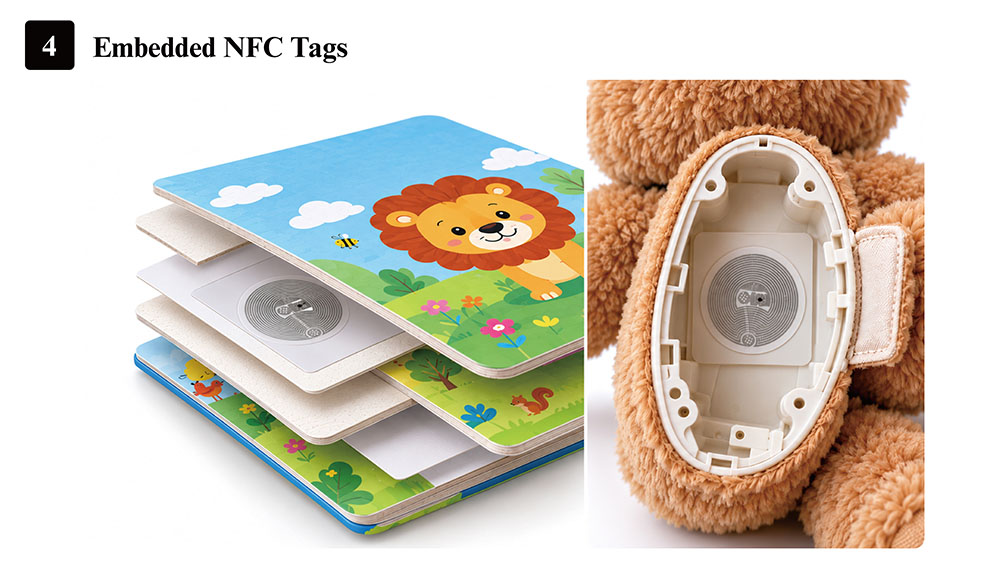
3. Embedded NFC Tags
Embedded NFC tags are used when the NFC component should be hidden inside the educational product.
Instead of applying a visible label to the surface, the NFC inlay or finished tag is integrated during manufacturing or assembly.
Typical applications
- interactive books
- laminated learning cards
- printed learning boards
- plastic educational toys
- molded toy parts
- product housings
- educational figures
- premium learning sets
Why choose embedded NFC tags?
Embedded NFC tags provide:
- a cleaner product appearance
- better protection from removal
- less visible technical hardware
- closer integration with the product structure
- more freedom for exterior design
This format is often selected when appearance, tamper resistance, and long-term product integration are more important than easy tag replacement.
Possible integration methods
Depending on the product, NFC tags may be:
- laminated between printed layers
- inserted inside a card structure
- placed inside a book cover
- fitted inside a plastic housing
- attached inside a toy component
- integrated before molding or final assembly
The production method must protect the antenna and chip from:
- excessive heat
- pressure
- bending
- cutting
- glue contamination
- incorrect placement
Embedded projects should therefore be reviewed before the product tooling and assembly process are finalized.
NFC Cards vs Stickers vs Embedded Tags
| Feature | NFC Cards | NFC Stickers | Embedded NFC Tags |
| Product form | Finished card | Adhesive label | Hidden component |
| Best for | Reusable learning sets | Existing products and flexible application | Integrated educational products |
| Durability | High | Depends on surface and construction | High when properly protected |
| Installation | Supplied as finished product | Applied during or after assembly | Integrated during production |
| Replaceability | Card can be replaced | Usually easier to replace | More difficult to replace |
| Visible NFC component | No separate label | Usually visible | Hidden |
| Printing area | Large | Depends on sticker size | Exterior product carries the design |
| Product development impact | Low to medium | Low | Medium to high |
| Typical volume | Small to large runs | Small to large runs | Better planned before mass production |
No format is universally better. The correct choice depends on how the NFC hardware fits into the educational product.
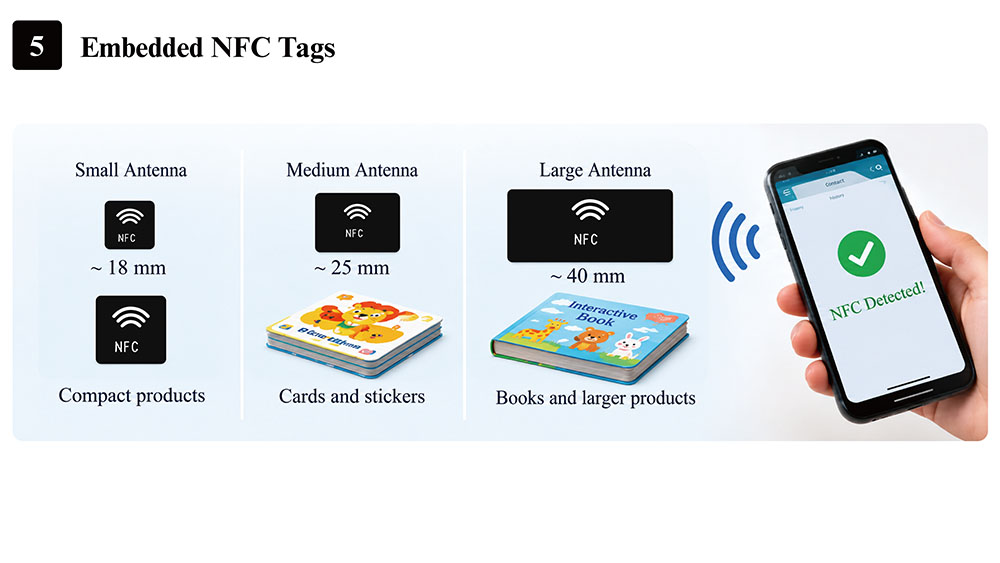
How to Choose the NFC Antenna Size
The NFC chip is only one part of the tag.
The antenna size and shape can affect how easily the product is tapped and read.
Larger antennas may provide a more forgiving tapping area, but they also require more space inside the product.
Smaller antennas are easier to integrate into compact products, but their final performance should be tested carefully.
Buyers should consider:
- available product space
- expected phone or reader position
- product thickness
- surrounding materials
- distance between the tag and product surface
- whether several NFC tags are placed close together
For cards, books, and learning boards containing multiple tags, tag spacing and antenna position should be reviewed before production.
Which NFC Chip Should Educational Products Use?
The right chip depends on what the product needs to store or identify.
NTAG213
Often considered for relatively simple applications such as:
- URL links
- product IDs
- basic tap-to-open content
- simple learning interactions
NTAG215 or NTAG216
May be considered when the project requires:
- more user memory
- longer stored data
- specific software compatibility
- more complex encoding requirements
However, a chip should not be selected only because it has more memory.
The project should first confirm:
- what data will be written
- whether the content is stored on the tag or online
- whether the tag will be locked
- whether data needs to be updated
- which phones or readers will be used
- whether password protection or stronger authentication is required
For products requiring more advanced security or authentication, a different NFC chip family may be more appropriate than a standard NTAG21x chip.
Printed Content vs NFC Content
Educational NFC products often contain two separate information layers.
Printed content
This may include:
- letters
- words
- pictures
- instructions
- numbers
- learning categories
- QR codes
NFC-encoded content
This may include:
- a URL
- product identification
- a content reference
- a unique number
- data used by the customer’s App or platform
NEXQO supplies the NFC hardware product and can provide chip encoding based on customer data.
The educational App, digital content, user interface, learning logic, and backend platform are normally provided by the customer or their software partner.
Before production, the physical NFC product and the customer’s digital platform should be tested together.
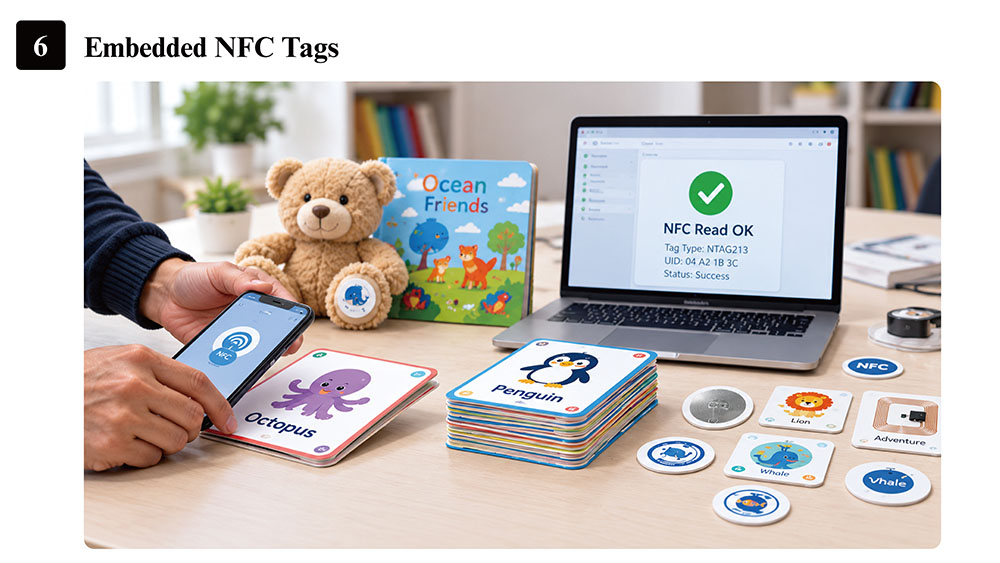
Product Development Considerations
1. Product structure
Confirm whether the NFC product will be:
- a finished card
- applied as a sticker
- laminated into printed material
- placed inside a toy
- installed behind a plastic surface
2. Product material
Materials around the tag can influence NFC performance.
Special attention is needed for:
- metal
- metallic printing
- foil
- thick plastic
- liquid
- batteries
- electronic components
3. User interaction
Decide where the user should tap.
The tapping area should be:
- easy to find
- comfortable to use
- consistent across the product
- supported by the artwork or instructions
4. Manufacturing process
Confirm when the NFC component will be added:
- before printing
- during lamination
- during product assembly
- before molding
- after the product is completed
5. Expected product life
A classroom learning card used every day requires a different structure from a promotional sticker used occasionally.
What Buyers Should Provide Before Quotation
To recommend the correct NFC product, manufacturers usually need:
- product type
- product dimensions
- available NFC installation area
- product material
- NFC format preference
- expected order quantity
- chip requirement
- encoded data requirement
- artwork quantity
- whether every item has different artwork
- whether every item requires different encoding
- expected tapping position
- target phone or reader
- assembly process
- sample testing requirements
For embedded NFC projects, product drawings or physical samples are especially useful.
Why Finished-Product Testing Is Important
Testing the NFC inlay by itself is not enough.
The complete educational product should be tested after:
- printing
- lamination
- adhesive application
- insertion
- molding
- assembly
- packaging
Testing should confirm:
- read reliability
- tapping position
- phone and reader compatibility
- chip data
- artwork and encoding matching
- antenna condition
- product durability
- performance after final assembly
For products containing multiple NFC tags, every intended tap position should be tested.
A Manufacturer’s Recommendation
When selecting an NFC format for an educational product, start with the physical product rather than the chip list.
Ask:
- Is the product a card, toy, book, board, or package?
- Will the NFC component be visible or hidden?
- Does the product already exist?
- How often will it be handled?
- Which material surrounds the tag?
- Where should the user tap?
- Does every item require unique artwork or encoding?
- Can the complete product be tested before mass production?
Once these questions are clear, it becomes easier to select:
- NFC card, sticker, or embedded tag
- material and structure
- antenna size
- chip model
- printing method
- adhesive
- encoding process
The best NFC product is the one that fits the educational product structure and remains reliable after final assembly.
FAQ
Are NFC cards or NFC stickers better for educational products?
NFC cards are generally better for reusable learning sets and flashcards. NFC stickers are more practical when adding NFC to an existing toy, package, board, or learning kit.
Can NFC tags be hidden inside educational toys?
Yes. NFC tags can be integrated inside many plastic housings or toy components, provided the surrounding material and manufacturing process are suitable.
Can NFC tags be embedded inside books?
Yes. They may be placed inside covers, laminated pages, inserts, or other printed structures. The final position and reading performance should be tested before mass production.
Which NFC chip is best for learning cards?
The best chip depends on data size, software compatibility, security requirements, and encoding method. NTAG213 is often considered for simple interactions, while NTAG215 or NTAG216 may be considered when more memory is needed.
Can NFC stickers be applied to metal?
A standard NFC sticker may not work correctly when applied directly to metal. An NFC anti-metal tag structure is normally required for metal surfaces.
Can every learning card have different artwork and NFC data?
Yes. NFC learning cards can be produced with variable artwork, serial numbers, and encoded data. The artwork and encoding database must be matched accurately during production.
Does NEXQO provide the educational App or software?
NEXQO focuses on NFC hardware products, printing, customization, and chip encoding. The App, digital content, and backend platform are normally provided by the customer or a software partner.
Conclusion
Choosing an NFC format for an educational product is mainly a product-structure decision.
- NFC cards are suitable for durable and reusable learning sets.
- NFC stickers are suitable for flexible application and existing product upgrades.
- Embedded NFC tags are suitable for hidden and integrated product designs.
The format should then be matched with the correct:
- material
- antenna
- chip
- adhesive
- printing
- encoding
- assembly method
For reliable mass production, the final educational product—not only the NFC chip or inlay—should be tested before the order is confirmed.
CTA
Developing an NFC educational product?
NEXQO supplies custom NFC learning cards, printed NFC stickers, anti-metal NFC tags, and embedded NFC inlays for educational toys, flashcards, books, learning boards, kits, and interactive printed products.
Share your product structure, dimensions, material, chip requirement, artwork quantity, encoding data, tapping position, and assembly method with our team. We can recommend suitable NFC formats, materials, antenna sizes, chip options, and samples for testing before production.