.png)
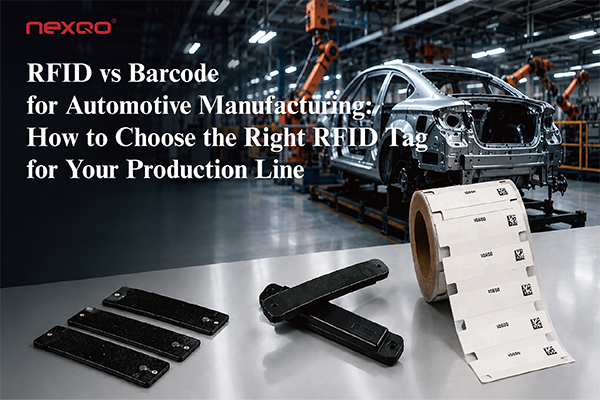
Compare barcode and RFID solutions for automotive manufacturing. Learn how to choose on-metal RFID tags, flexible RFID tags, FPC RFID tags, and high-temperature RFID tags for different automotive components and production environments.
Introduction
Automotive manufacturing requires accurate identification throughout the production process.
From metal components and body parts to electronic modules and returnable containers, manufacturers need identification solutions that can work in different environments.
Barcode remains a practical option for many simple labeling applications.
However, automotive production often creates more challenging conditions:
- metal surfaces
- curved components
- limited installation space
- high-temperature processes
- repeated handling
- automated inventory requirements
This is where specialized RFID tags become valuable.
The key question is not:
Is RFID better than barcode?
The better question is:
Which identification method and RFID tag structure best fit the production environment?
A practical starting point:
- Barcode → simple identification and manual scanning
- Standard RFID labels → general non-metal applications
- On-metal RFID tags → metal components and equipment
- Flexible RFID tags → curved or irregular surfaces
- FPC RFID tags → small electronic components with limited space
- High-temperature RFID tags → demanding production processes
Choosing the right RFID tag structure is often as important as choosing RFID technology itself.
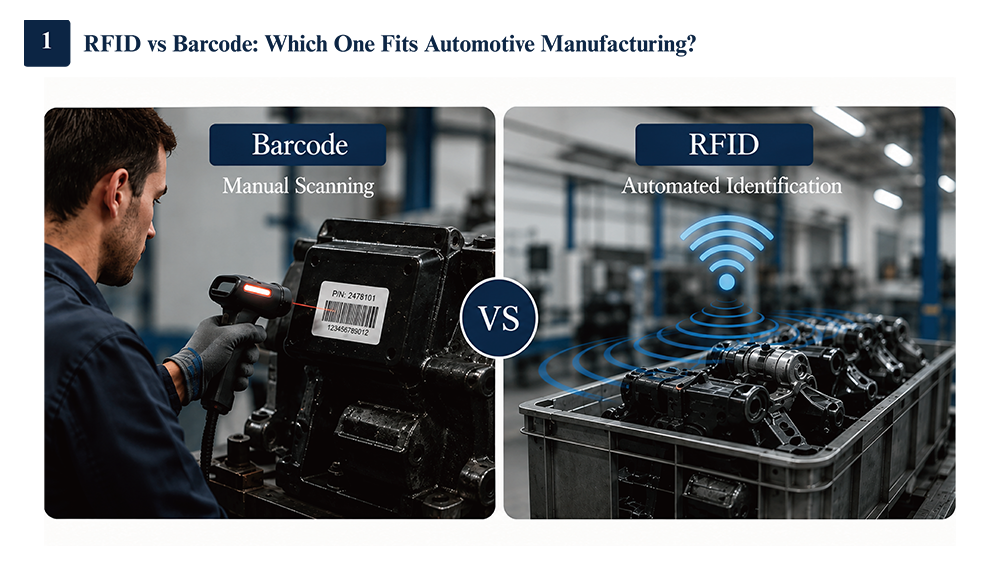
RFID vs Barcode: Which One Fits Automotive Manufacturing?
Both barcode and RFID have their place in automotive production.
The right choice depends on the production requirement.
| Requirement | Recommended Solution |
| Simple part identification | Barcode |
| Manual scanning process | Barcode |
| Automated identification | RFID |
| Multiple items reading | RFID |
| Metal component tracking | RFID with suitable tag structure |
| Automated inventory | RFID |
| High-temperature process | High-temperature RFID tag |
| Small electronic parts | FPC RFID tag |
Barcode remains practical for straightforward identification.
RFID becomes more attractive when manufacturers need:
- less manual scanning
- automated data collection
- identification in difficult environments
- higher flexibility across production stages
Why Automotive Manufacturing Needs Specialized RFID Tags
Automotive components are not all the same.
A tag that works on a plastic container may fail on:
- engine components
- metal chassis parts
- curved body panels
- electronic modules
- painted components
- high-temperature production areas
The main factors affecting RFID tag selection include:
- material surface
- available installation space
- temperature exposure
- required reading distance
- durability requirements
- attachment method
This is why automotive RFID projects usually require different tag formats for different components.
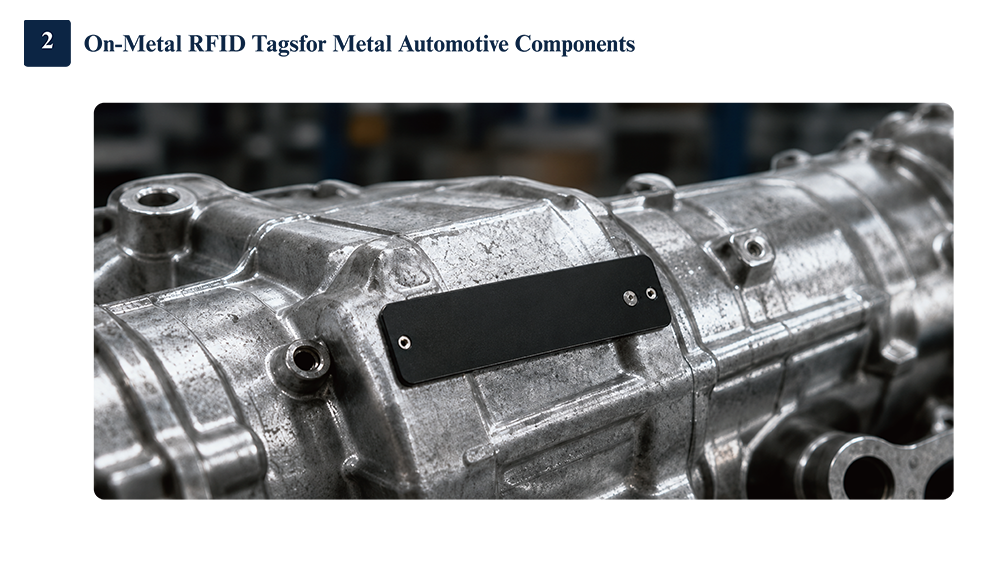
On-Metal RFID Tags for Metal Automotive Components
Metal is one of the most common challenges in RFID applications.
Standard RFID labels may experience reduced performance when attached directly to metal because the metal surface can affect antenna performance.
On-metal RFID tags are designed specifically for these applications.
Typical applications
- engine components
- chassis parts
- metal containers
- production fixtures
- tooling equipment
- server and equipment cabinets
Common structures
Depending on the application, on-metal RFID tags may use:
- flexible RFID structures
- ABS hard tags
- FR4 tags
- ceramic-based structures
- industrial adhesive mounting
Why choose on-metal RFID tags?
They are commonly selected when the project requires:
- reliable identification on metal surfaces
- stronger mechanical protection
- longer service life
- stable attachment
The correct design depends on:
- metal surface condition
- installation location
- required reading distance
- environmental exposure
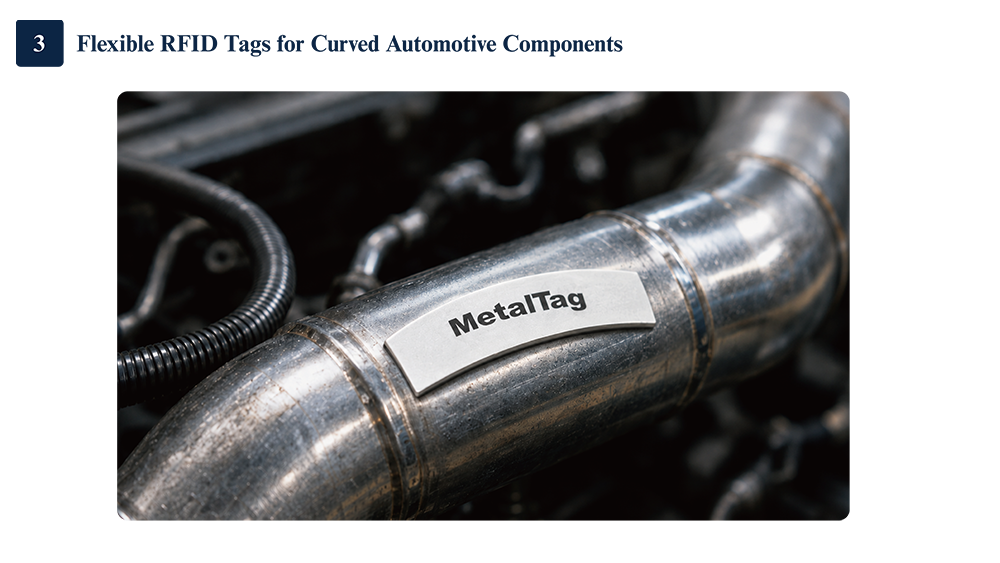
Flexible RFID Tags for Curved Automotive Components
Not every automotive part provides a flat mounting surface.
Flexible RFID tags are useful when components have:
- curved surfaces
- irregular shapes
- limited installation areas
Typical applications
- body panels
- pipes
- tubes
- curved metal components
- automotive assemblies
Advantages
Flexible RFID tags provide:
- easier installation
- better fit on irregular surfaces
- lower profile compared with rigid tags
- more design flexibility
They are often selected when a standard rigid tag cannot fit the component geometry.
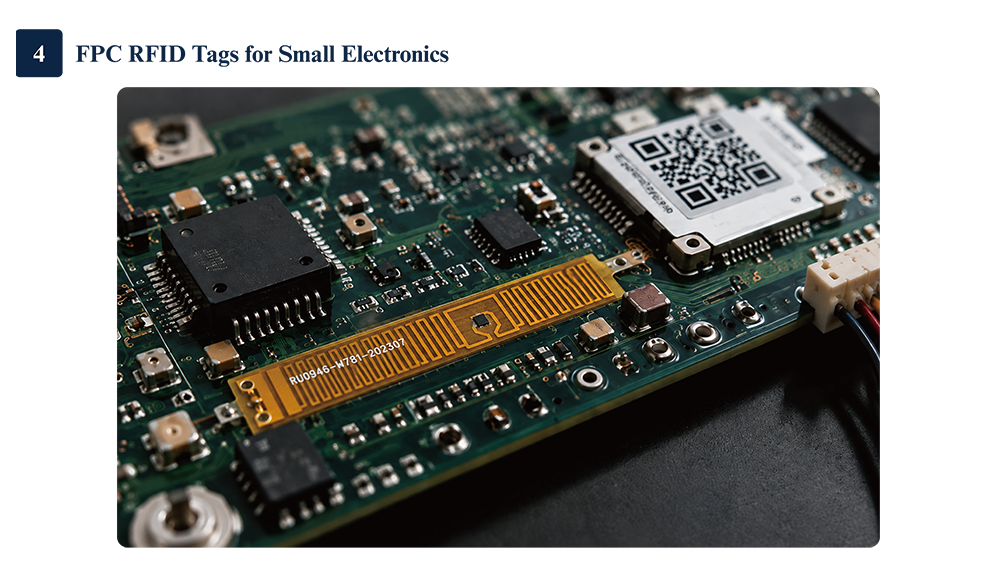
FPC RFID Tags for Small Automotive Electronics
Modern vehicles contain many electronic components.
These parts often require smaller RFID solutions.
FPC RFID tags are designed for applications where installation space is limited.
Typical applications
- wire harnesses
- electronic control modules
- sensors
- PCB assemblies
- small automotive electronics
Why choose FPC RFID tags?
They provide:
- ultra-thin structure
- flexible installation options
- compatibility with small components
- easier integration into compact assemblies
For automotive electronics, tag size and antenna design often become the key selection factors.
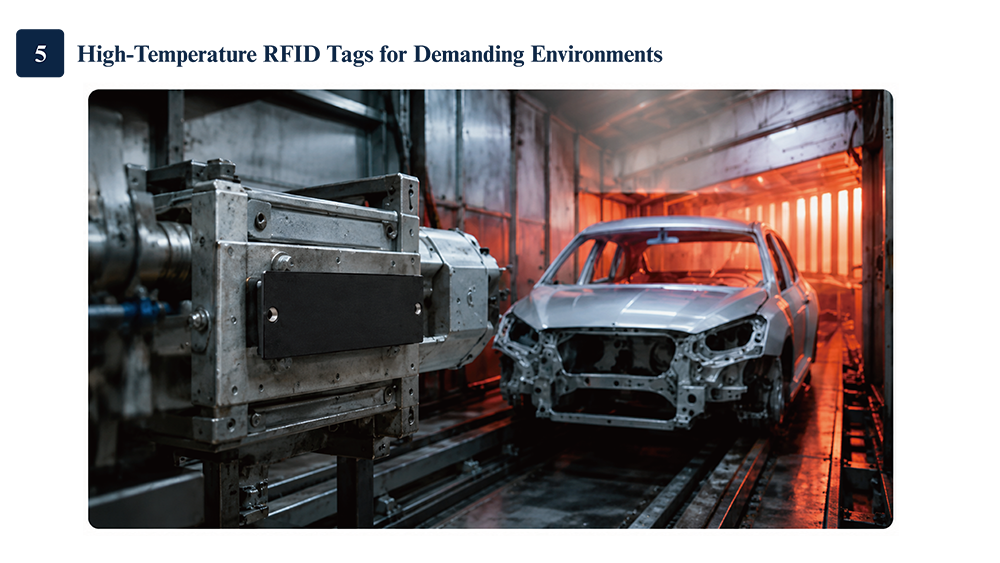
High-Temperature RFID Tags for Automotive Production
Some automotive manufacturing processes expose components to elevated temperatures.
Examples include:
- paint shops
- curing processes
- heat treatment
- industrial production stages
Standard RFID labels may not be suitable for these environments.
High-temperature RFID tags are designed for applications requiring stronger temperature resistance.
Typical applications
- automotive production tracking
- paint process identification
- heat-exposed components
- industrial returnable assets
The actual temperature capability depends on:
- tag structure
- materials
- adhesive
- installation method
- exposure duration
For high-temperature applications, testing the complete tag under actual production conditions is strongly recommended.
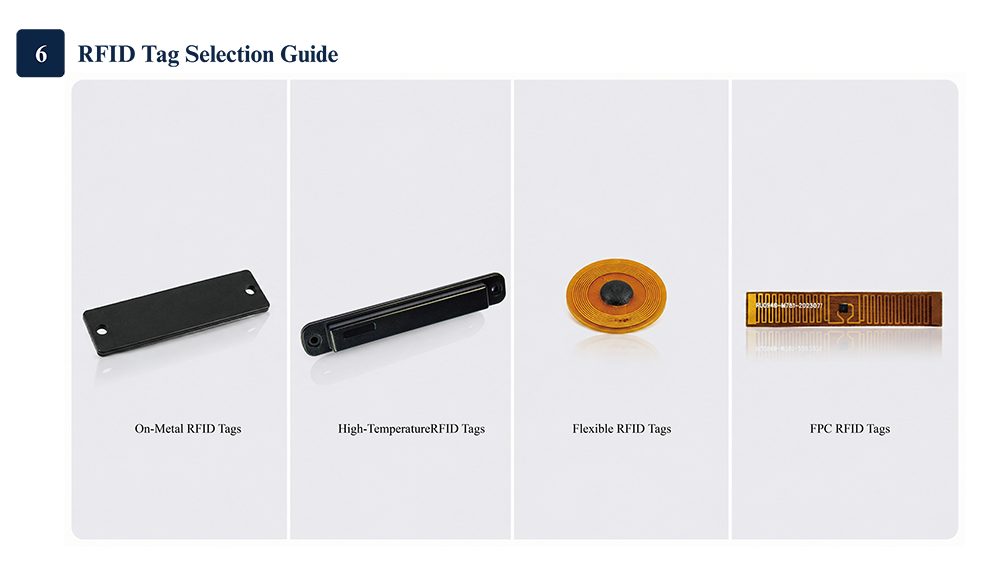
How to Choose the Right RFID Tag for Automotive Applications
| Production Environment | Recommended RFID Product |
| Metal components | On-metal RFID tags |
| Curved surfaces | Flexible RFID tags |
| Small electronic parts | FPC RFID tags |
| High-temperature processes | High-temperature RFID tags |
| Plastic components | Standard RFID labels |
| Returnable containers | Durable RFID asset tags |
The best RFID tag is determined by the component, not only the industry.
RFID Tag Selection Factors Automotive Buyers Should Confirm
Before choosing an RFID tag, manufacturers should confirm:
1. Component Material
Is the surface:
- metal?
- plastic?
- painted?
- composite?
- electronic?
The material directly affects RFID performance.
2. Installation Space
Confirm:
- available area
- flat or curved surface
- thickness limitation
- attachment method
Small spaces may require FPC or customized RFID structures.
3. Production Environment
Consider:
- temperature
- moisture
- chemicals
- vibration
- cleaning process
- handling conditions
4. Reading Requirement
Confirm:
- reading distance
- fixed reader or handheld reader
- single item or bulk reading
- reading direction
5. Expected Product Life
Different applications require different durability levels.
A temporary production label and a long-term component identification tag should not use the same structure.
Customization Options for Automotive RFID Tags
Automotive RFID tags can be customized with:
- different sizes
- different antenna designs
- different materials
- printed information
- barcode
- QR code
- serial number
- EPC encoding
- UID matching
- adhesive options
- mounting methods
For automotive projects, customization is often required because every component has different physical conditions.
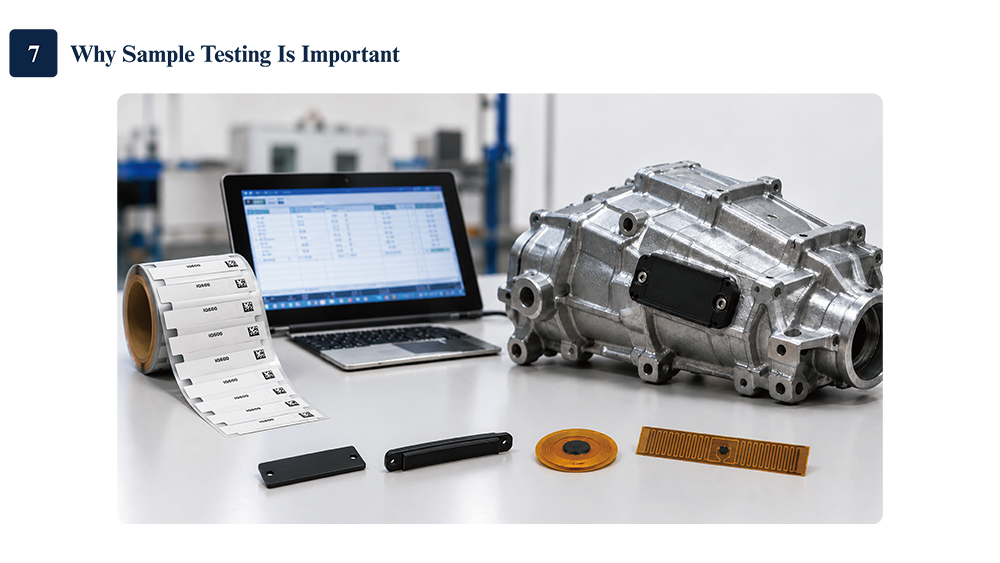
Why Sample Testing Is Important
Automotive environments are complex.
Testing only the RFID tag itself is not enough.
The complete application should be tested:
- on the actual component
- in the actual mounting position
- with the actual reader
- under the expected environment
Testing should confirm:
- reading performance
- attachment reliability
- temperature resistance
- data encoding
- long-term stability
Especially for:
- metal parts
- high-temperature processes
- small electronic components
sample testing before mass production is strongly recommended.
What NEXQO Provides
NEXQO focuses on RFID hardware solutions for industrial applications.
We provide:
- on-metal RFID tags
- flexible RFID tags
- FPC RFID tags
- high-temperature RFID tags
- RFID asset labels
- custom RFID inlays
- printing
- barcode and QR customization
- EPC encoding
- sample development
NEXQO does not provide MES, ERP, manufacturing execution software, traceability platforms, or production management systems.
These systems are normally provided by automotive manufacturers or their software/system integration partners.
Our role is to provide the RFID hardware that matches the production environment and identification requirements.
FAQ
Is RFID better than barcode for automotive manufacturing?
Not always. Barcode remains suitable for simple identification. RFID is often selected when manufacturers need automated identification, difficult-environment tracking, or higher inventory efficiency.
Can RFID tags work on metal automotive parts?
Yes. On-metal RFID tags are specifically designed for metal surfaces where standard RFID labels may not perform reliably.
What RFID tag is suitable for small automotive components?
FPC RFID tags are commonly used for small electronic components, wire harnesses, sensors, and assemblies with limited installation space.
Can RFID tags survive automotive production environments?
Specialized RFID tags are available for demanding environments such as metal surfaces and high-temperature processes. The correct design depends on the actual application conditions.
Can one RFID tag be used for all automotive parts?
Usually not. Different components require different tag structures based on material, shape, temperature, and installation requirements.
Conclusion
RFID and barcode are not competing technologies for every automotive application.
Barcode remains practical for simple identification tasks.
RFID becomes more valuable when manufacturers require:
- automated identification
- difficult-environment tracking
- metal component identification
- production visibility
- scalable asset tracking
For automotive manufacturing, selecting the right RFID tag structure is often the key factor.
Whether the application requires:
- on-metal RFID tags
- flexible RFID tags
- FPC RFID tags
- high-temperature RFID tags
the solution should always be matched to the real production environment.
CTA
Planning an automotive RFID project?
NEXQO provides customized RFID tags for automotive manufacturing, including on-metal RFID tags, flexible RFID tags, FPC RFID tags, high-temperature RFID tags, and RFID asset labels.
Share your component material, installation space, production environment, reader system, and testing requirements with our team. We can recommend suitable RFID tag structures and prepare samples for evaluation before production.