.png)
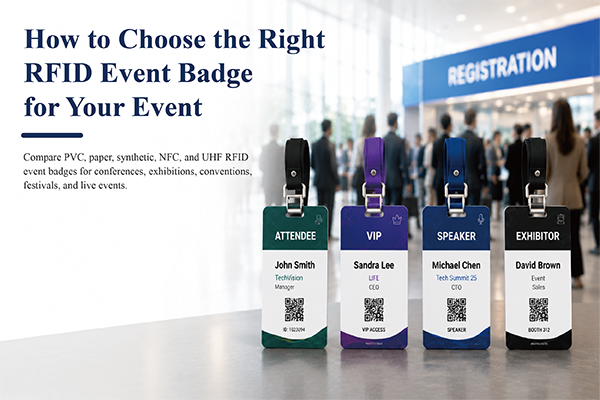
Compare PVC, paper, synthetic, NFC, and UHF RFID event badges for conferences, exhibitions, conventions, festivals, and live events.
Introduction
Choosing an RFID event badge is not only about selecting a chip.
The badge also needs to match:
- the event duration
- the reading method
- the venue environment
- attendee categories
- printing and personalization requirements
- branding expectations
For most buyers, the first question should be:
Which RFID event badge is most suitable for this event?
A practical starting point is:
PVC RFID badges for professional conferences, exhibitions, VIP events, and multi-day use
Paper RFID badges for short-term, cost-sensitive indoor events
Synthetic RFID badges for lightweight badges requiring better tear and moisture resistance
NFC event badges for tap-based access, check-in, or attendee interaction
UHF RFID event badges for projects designed around longer-range or less hands-on identification
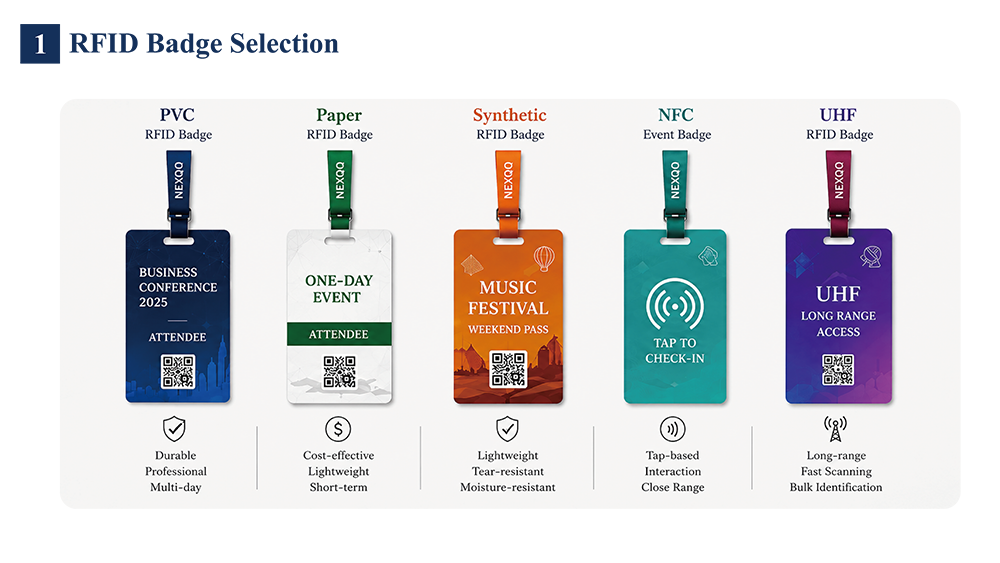
The best result usually comes from selecting the badge material, RFID technology, printing method, and personalization format as one complete product.
Quick Product Selection Guide
| Event Requirement | Recommended RFID Badge |
| Business conference | PVC RFID badge |
| Trade show or exhibition | PVC RFID badge |
| One-day indoor event | Paper RFID badge |
| Multi-day event | PVC or synthetic RFID badge |
| Outdoor or moisture-exposed event | Synthetic or PVC RFID badge |
| VIP or sponsor-focused event | Premium PVC RFID badge |
| Tap-based access or interaction | NFC event badge |
| Longer-range identification setup | UHF RFID event badge |
| On-site badge printing | Printer-compatible RFID badge |
| Multiple attendee categories | Variable-data RFID badges |
This table is a starting point. Final selection should still match the reader system and actual event workflow.
1. PVC RFID Event Badges
PVC RFID badges are one of the most common choices for professional and branded events.
They are usually selected when the buyer needs:
durable construction
high-quality full-color printing
a clean and professional appearance
good resistance to normal handling
enough space for attendee and sponsor information
Common applications
business conferences
trade shows
exhibitions
corporate events
VIP programs
speaker and exhibitor credentials
multi-day indoor events
Available customization
PVC RFID badges can include:
attendee name
company name
job title
photograph
attendee category
QR code
barcode
serial number
sponsor logo
event artwork
chip encoding
For events where the badge is also part of the brand presentation, PVC is often the strongest option.
2. Paper RFID Event Badges
Paper RFID badges are more suitable for short-duration events where cost and volume are important.
Common applications
one-day conferences
training sessions
temporary visitor badges
large-volume indoor meetings
short-term registration programs
Main advantages
lightweight
cost-efficient
easy to print
suitable for limited-use events
Paper RFID badges are generally better for controlled indoor environments.
For events involving moisture, repeated handling, outdoor use, or premium branding, PVC or synthetic materials are usually more practical.
3. Synthetic RFID Event Badges
Synthetic RFID badges provide a middle option between paper and rigid PVC.
They are lighter than PVC but generally offer better durability than ordinary paper.
Common applications
multi-day events
outdoor or semi-outdoor events
festivals
conventions
badges handled repeatedly
events requiring tear resistance
Main advantages
lightweight construction
better tear resistance than paper
improved moisture resistance
suitable for longer wearing periods
good printing flexibility
Synthetic materials are often selected when the buyer wants a flexible badge without giving up too much durability.
4. NFC Event Badges
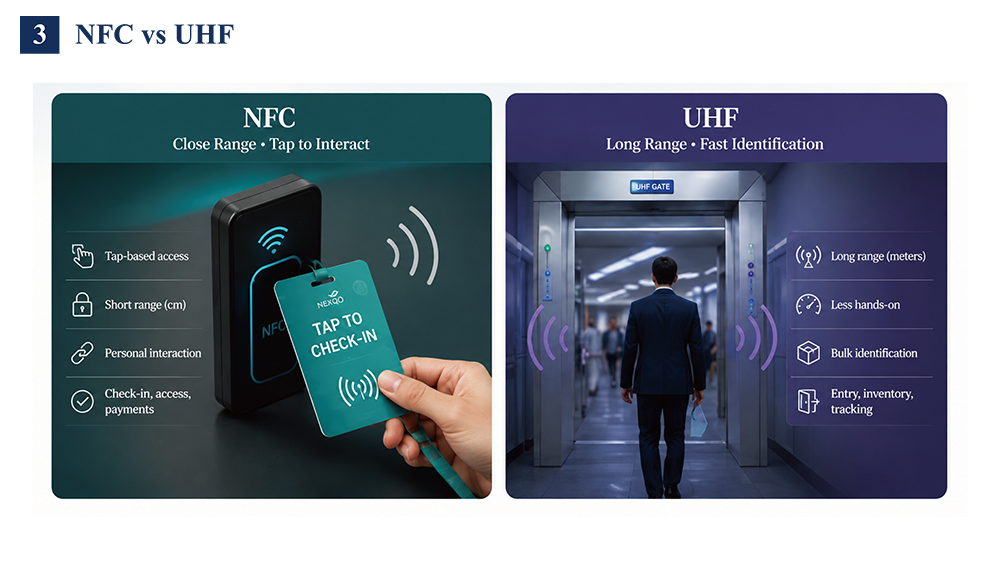
NFC event badges are commonly used for close-range, tap-based applications.
The attendee normally taps or presents the badge near a compatible reader.
Typical applications
event entry
VIP access
session check-in
booth interaction
attendee self-service
digital content access
loyalty or promotional activities
NFC badges are often selected when the event wants a clear and intentional interaction at each checkpoint.
They can be produced using PVC, paper, or synthetic badge structures depending on the project.
5. UHF RFID Event Badges
UHF RFID badges may be considered when the event system is designed for longer-range or less deliberate identification.
Possible applications
portal-based access points
staff or exhibitor identification
selected zone monitoring
large-scale credential reading
event workflows requiring less frequent tapping
UHF badge performance depends on more than the chip.
It is also affected by:
antenna size
badge orientation
how the badge is worn
reader position
surrounding people
venue layout
For this reason, UHF event badges should be tested with the actual reader setup before mass production.
RFID Event Badge Materials Compared
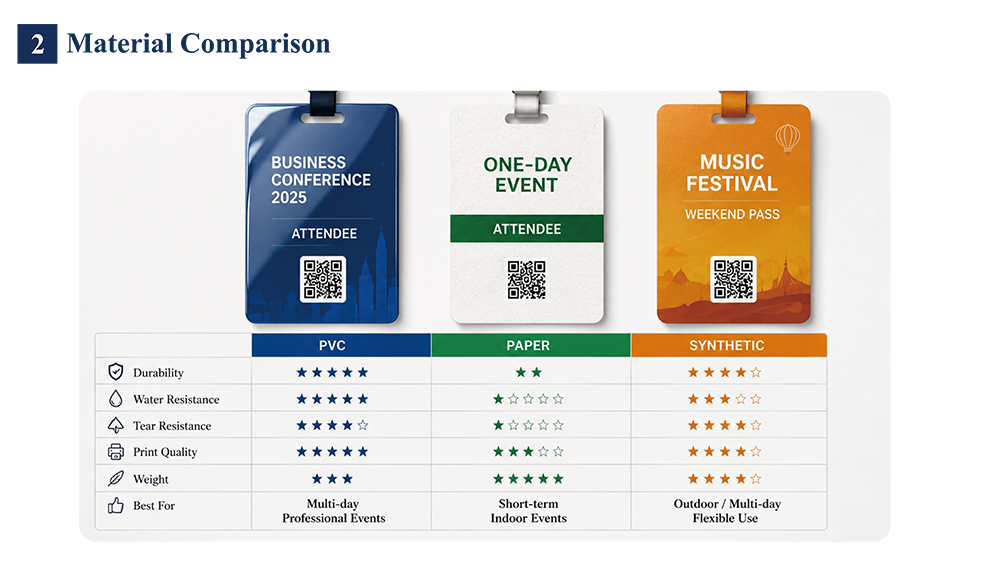
| Feature | PVC Badge | Paper Badge | Synthetic Badge |
| Durability | High | Basic | Medium to high |
| Water resistance | Good | Limited | Better than paper |
| Print quality | Excellent | Good | Good |
| Weight | Heavier | Very light | Light |
| Best for | Professional and premium events | Short-term indoor use | Multi-day and outdoor use |
| Branding space | Excellent | Good | Good |
| Repeated handling | Suitable | Limited | Suitable |
The material should be selected based on actual use, not only unit price.
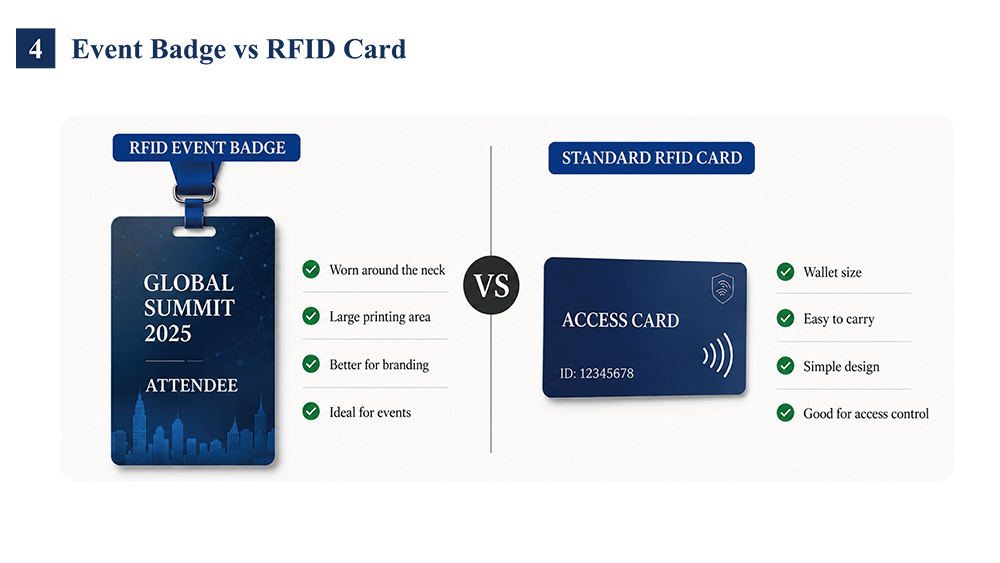
RFID Event Badges vs Standard RFID Cards
RFID event badges and RFID cards can use similar chip technologies, but their product formats serve different needs.
| RFID Event Badge | Standard RFID Card |
| Larger printable area | Standard card size |
| Usually worn with a lanyard | Usually carried in a wallet |
| Better visible identification | More compact |
| Strong sponsor and event branding | Better for long-term use |
| Suitable for temporary events | Suitable for membership and access programs |
RFID badges are generally better when the attendee’s identity and category need to be visible throughout the event.
RFID cards are more suitable for long-term employee, membership, hotel, or access-control use.
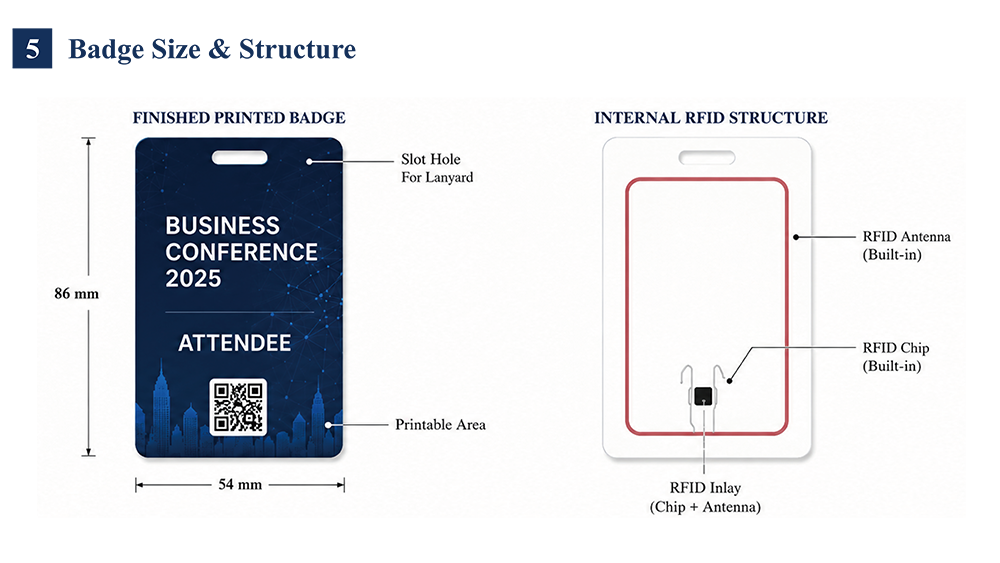
RFID Event Badge Size and Structure
Badge size affects both appearance and RFID performance.
Buyers should consider:
amount of attendee information
event and sponsor artwork
QR code or barcode size
photograph requirements
RFID antenna size
hole position
lanyard attachment
wearing comfort
A larger badge provides more branding space, but may feel heavier.
A smaller badge is easier to wear, but may limit artwork, text, and antenna options.
The badge size, RFID inlay, hole position, and artwork should therefore be reviewed together before production.
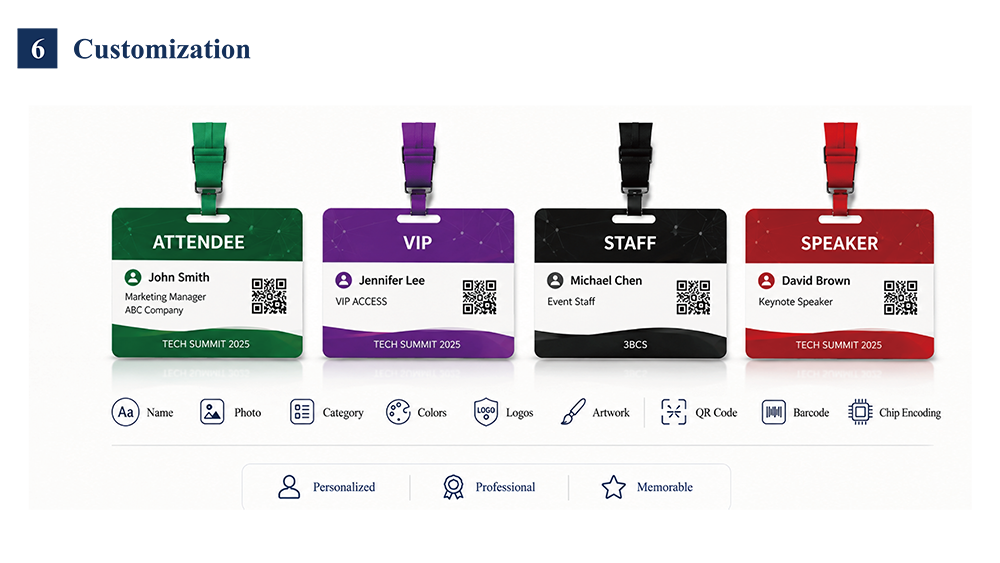
Customization Options
NEXQO RFID event badges can be customized with:
full-color printing
variable attendee names
company names
job titles
photographs
attendee categories
QR codes
barcodes
serial numbers
sponsor logos
different color layouts
chip encoding
custom badge sizes
custom hole positions
Different designs can be used to separate:
general attendees
speakers
exhibitors
VIP guests
staff
media
sponsors
Even when RFID permissions are managed electronically, clear visual identification remains important at live events.
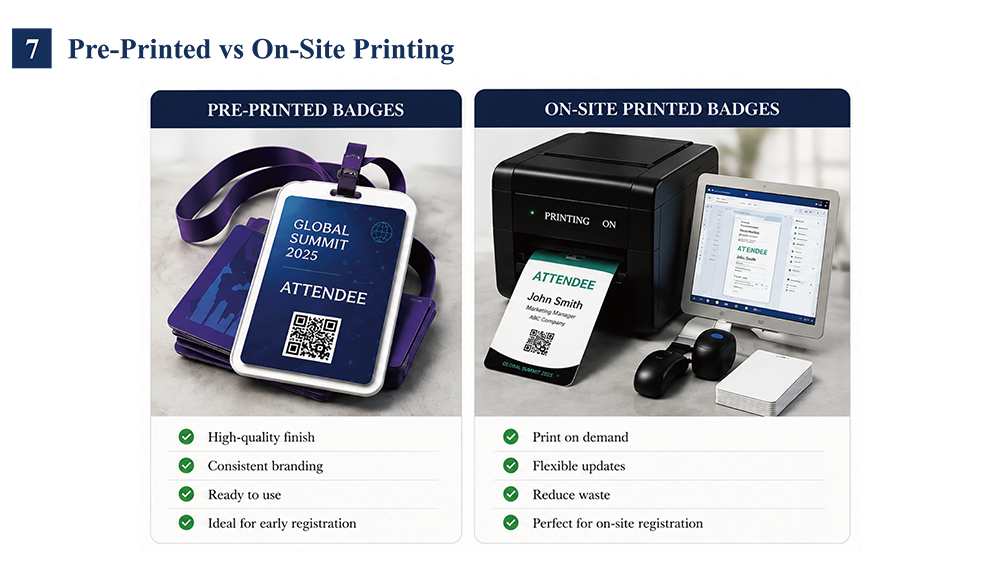
Pre-Printed Badges vs On-Site Printed Badges
Another important product decision is how attendee information will be printed.
Pre-Printed RFID Badges
Suitable when attendee data is confirmed before the event.
Advantages include:
more printing options
better control of artwork
easier variable-data matching
less pressure at the registration desk
On-Site Printed RFID Badges
Suitable when attendees register late or badge information may change.
The badge material and surface must be compatible with the selected printer.
Buyers should confirm:
printer model
print method
printable area
badge thickness
RFID inlay position
required data format
Printer compatibility should be tested before production.
What Buyers Should Confirm Before Ordering
Before placing an RFID event badge order, buyers should confirm the following product specifications.
RFID requirements
frequency
chip model
memory requirement
encoding requirement
reader compatibility
expected reading method
Badge specifications
material
dimensions
thickness
shape
hole position
lanyard or clip type
Printing requirements
artwork
attendee name
company name
photograph
QR code
barcode
serial number
attendee category
Project requirements
quantity
event date
indoor or outdoor use
one-day or multi-day use
pre-printed or on-site printing
data matching requirements
Providing these details early helps reduce unnecessary sampling and production changes.
Why Complete Badge Testing Matters
Testing only the RFID chip is not enough.
The complete badge should be tested for:
actual reader compatibility
reading performance
antenna orientation
badge wearing position
printing quality
variable-data accuracy
barcode or QR code readability
lanyard-hole strengthmaterial durability
This is especially important for UHF badges and badges intended for on-site printing.
For many event projects, testing the finished badge is the most practical step before mass production.
A Manufacturer’s Recommendation
When buyers ask us which RFID event badge they should use, we usually begin with the product conditions:
What type of event is it?
How many days will the badge be used?
Will attendees tap the badge or pass through a reading zone?
Is the event indoors or outdoors?
How much attendee and sponsor information must be printed?
Will badges be printed before the event or on site?
Which RFID reader and system are already in use?
Once these details are clear, it becomes much easier to recommend:
the badge material
the RFID frequency
the chip
the badge size
the printing method
the personalization process
The best badge is not necessarily the most expensive one. It is the one that fits the event process and performs reliably with the existing system.
FAQ
Which material is best for RFID event badges?
PVC is often selected for professional, branded, and multi-day events. Paper is more suitable for short-term indoor projects, while synthetic materials are useful when lightweight construction and better tear or moisture resistance are required.
Can RFID event badges include attendee names and photos?
Yes. RFID badges can be personalized with names, companies, job titles, photographs, QR codes, barcodes, serial numbers, and attendee categories.
Should I choose NFC or UHF RFID event badges?
NFC is commonly used for close-range tap-based interaction. UHF may be considered for longer-range or less hands-on identification. The correct option depends on the event reader system and workflow.
Can RFID badges be printed on site?
Yes, but the badge material, surface, thickness, and RFID inlay position must be compatible with the selected printer.
Can one event use different RFID badge designs?
Yes. Different artwork, colors, printed categories, or encoding data can be used for attendees, staff, speakers, exhibitors, VIP guests, and media.
Do RFID event badges require testing?
Yes. Sample testing is recommended to confirm reader compatibility, actual reading performance, printing quality, wearing position, and personalization accuracy.
Conclusion
Choosing the right RFID event badge is mainly a product-selection decision.
The buyer needs to match:
RFID technology
badge material
event duration
printing method
attendee data
wearing conditions
reader compatibility
PVC, paper, synthetic, NFC, and UHF event badges each serve different project requirements.
For most events, the best solution is the badge that provides the right balance of identification, durability, branding, personalization, and RFID performance.
CTA
Looking for custom RFID event badges?
NEXQO provides PVC, paper, synthetic, NFC, and UHF RFID event badges with custom sizes, full-color printing, variable attendee data, QR codes, barcodes, serial numbers, chip encoding, and lanyard options.
Share your event type, badge quantity, material preference, reader system, personalization requirements, and delivery schedule with our team. We can recommend suitable product options and prepare samples for testing before production.