.png)
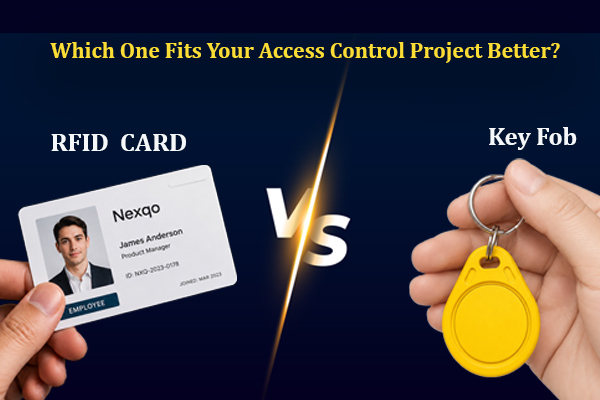
A practical guide for buyers comparing RFID cards and key fobs based on daily use, durability, branding needs, and long-term project fit.
Introduction
In most access control projects, the question is not whether RFID works.
The more practical question is:
Which credential format fits daily use better—RFID cards or RFID key fobs?
Both can support access control. Both can be produced with compatible chip options depending on the system requirement. But in real projects, the difference usually shows up in how the credential is carried, how often it is handled, and how well it holds up over time.
From a project and manufacturing perspective, the better choice usually depends less on the chip itself and more on usage conditions, user habits, and lifecycle expectations.
Why RFID Cards and Key Fobs Are Often Compared
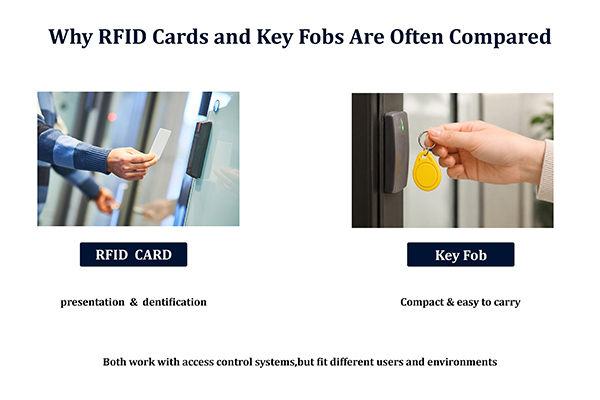
RFID cards and RFID key fobs are both common formats in access control systems.
They are often compared because they can serve the same core function, but they behave differently in day-to-day use.
The real decision usually comes down to:
- how users carry the credential
- how often it is used
- whether branding matters
- how much wear the credential is likely to face
- whether the system is designed for guests, residents, employees, or long-term users
Where RFID Cards Usually Work Better
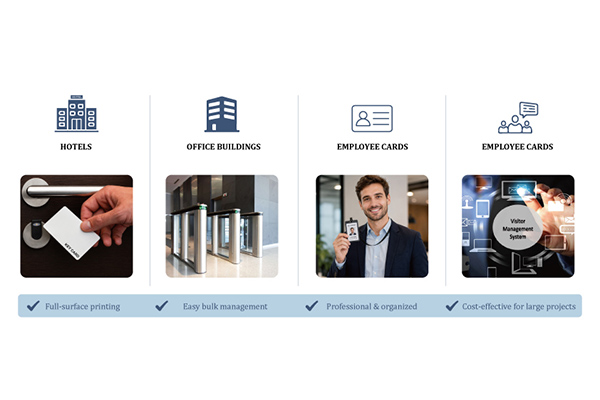
RFID cards are commonly selected in structured environments where presentation, identification, and bulk management matter.
Typical applications
- hotels
- office buildings
- employee ID programs
- campuses
- visitor systems
Why buyers choose RFID cards
From an operational perspective, RFID cards are often preferred because they offer:
- a professional and familiar format
- full-surface printing for logo, photo, ID, or numbering
- easier bulk issuing and collection
- practical cost control for larger deployments
- a standard format that works well in organized environments
For hotels and office access programs, cards are often the more natural choice because they fit existing workflows and visual identity requirements. This direction is consistent with the original draft’s positioning of cards for hotels, offices, and structured systems.
Where RFID Key Fobs Make More Sense
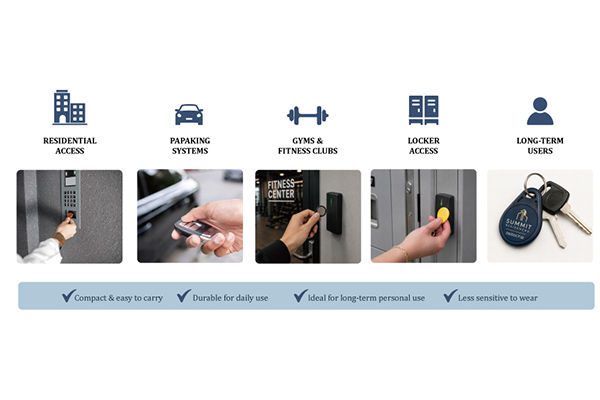
RFID key fobs are usually the stronger option when the credential is handled frequently and expected to stay with the user for a long time.
Typical applications
- residential access
- apartment buildings
- parking systems
- gyms and fitness clubs
- locker access
- long-term assigned users
Why buyers choose RFID key fobs
In many projects, key fobs are selected because they are:
- compact and easy to carry
- practical for attachment to keys or lanyards
- less sensitive to bending or edge wear
- better suited to repeated everyday handling
- often more convenient for long-term personal use
For resident access or gym membership use, key fobs often feel more natural because users tend to keep them attached to items they already carry every day. This matches the original draft’s use-case direction for residential, gym, and daily-use environments.
What Buyers Usually Consider First
In actual sourcing decisions, the better choice usually becomes clearer when buyers answer a few practical questions.
1. Does the project require visible branding or printed identity?
If yes, RFID cards usually make more sense because they provide a full printable surface.
2. Will the credential be used and carried every day?
If yes, RFID key fobs are often more practical for long-term personal use.
3. Is the environment controlled or less controlled?
Cards are often better for structured environments.
Key fobs are often a better fit for more casual, high-use, or rougher day-to-day conditions.
4. Is bulk issuing and collection important?
Cards are often easier to organize, issue, and recover in large quantities.
5. Is durability more important than presentation?
If yes, key fobs often have an advantage in frequent-use scenarios.
RFID Card vs Key Fob: Quick Comparison
| Feature | RFID Card | RFID Key Fob |
| Form factor | Credit card size | Compact, keychain style |
| Carrying method | Wallet, badge holder, lanyard | Keys, lanyard, pocket |
| Branding space | Full surface printing | Limited |
| Daily durability | Moderate | Better for repeated handling |
| Bulk management | Easier in structured systems | Less ideal for visual ID use |
| Typical users | Guests, employees, visitors | Residents, members, long-term users |
| Best fit | Hotels, offices, formal ID systems | Residential access, gyms, parking |
Why Many Projects Use Both
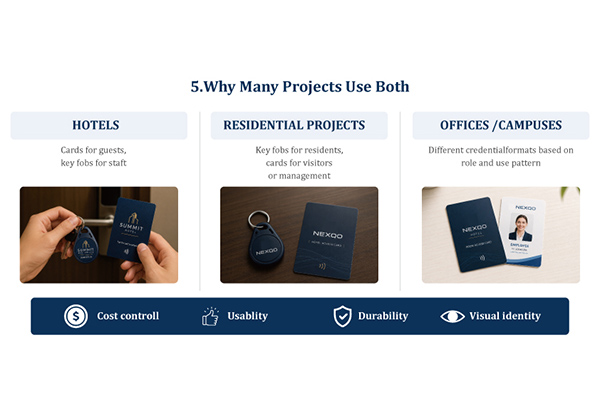
In many real projects, the best decision is not choosing one format only.
It is choosing where each format makes more sense.
Common mixed-use setups
- Hotels:cards for guests, key fobs for staff
- Residential projects:key fobs for residents, cards for visitors or management
- Offices or campuses:different credential formats depending on role and use pattern
This mixed approach often gives a better balance between:
- cost control
- usability
- durability
- visual identity
For many system operators, that is more practical than forcing one credential format onto every user type. This mixed-use logic is already present in your draft and is worth keeping because it is very realistic from a project standpoint.
A Manufacturer’s View: Start With Daily Use, Not Just the Format Name
From a manufacturing perspective, buyers sometimes start by asking whether cards or key fobs are “better.”
In most cases, the better question is:
- how will the credential actually be used every day?
- will it be carried in a wallet, on a lanyard, or with keys?
- does it need visual identity or branding?
- is it for guests, staff, residents, or members?
- how important is long-term wear resistance?
Once these points are clear, the more suitable format usually becomes obvious.
In many access control projects, sample testing is also useful before a full rollout. It helps confirm:
- chip compatibility
- user handling preference
- print quality
- housing quality
- everyday suitability
FAQ
Are RFID key fobs more durable than RFID cards?
In many high-use environments, yes. Key fobs are often preferred when repeated daily handling and wear resistance matter more than printable surface area.
Are RFID cards cheaper than key fobs?
In many bulk projects, cards are often the more cost-efficient option, especially when structured issuance and standard formatting are priorities.
Can RFID cards and key fobs work in the same system?
Yes, as long as the chip type, frequency, and system compatibility are aligned.
Which is better for hotels: RFID cards or key fobs?
RFID cards are more commonly used in hotels because they fit guest workflows, branding needs, and standard room-key processes.
Which is better for long-term users?
RFID key fobs are often more practical for long-term users such as residents, members, or regular staff because they are easy to carry and suited to repeated use.
Which option is easier to manage in bulk?
RFID cards are usually easier to issue, collect, and visually organize in larger quantities, especially in structured systems.
Conclusion
There is no single best choice for every access control project.
RFID cards usually make more sense when the project needs:
- structured issuing
- visible branding
- printed identity
- guest or employee-facing presentation
RFID key fobs usually make more sense when the project needs:
- compact everyday carry
- repeated daily use
- better resistance to wear
- long-term personal assignment
For many buyers, the most effective approach is not asking which one is universally better.
It is asking which one fits the user, the environment, and the workflow better.
CTA
Not sure whether RFID cards or key fobs fit your access control project better?
Share your application, user type, branding needs, and system requirement with NEXQO. We can suggest suitable options and provide samples for practical evaluation before bulk production.