.png)
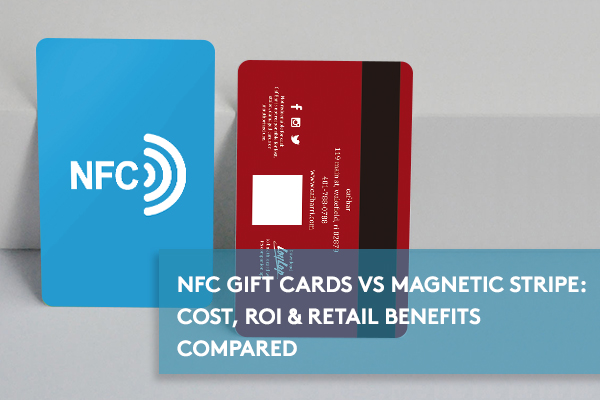
In recent years, contactless technology has become standard across payment systems. Many retailers are now evaluating whether NFC gift cards are worth upgrading from traditional magnetic stripe cards.
In markets where retail experience and premium presentation play an important role, gift card design and functionality are increasingly viewed as part of brand positioning.
However, beyond innovation and aesthetics, the key business question remains:
Do NFC gift cards deliver measurable return on investment?
In this article, we break down the ROI factors retailers should consider before making the switch.
1. Upfront Cost: Higher Than Magnetic Stripe
There is no doubt that NFC gift cards cost more to produce than traditional magnetic stripe cards.
The additional cost comes from:
- Embedded NFC chip (commonly NTAG series)
- Antenna integration
- Encoding process
- Testing and quality control
Depending on chip type and order volume, NFC cards may cost 30–70% more per unit than magnetic stripe versions.
From a pure unit-cost perspective, magnetic stripe cards remain cheaper. However, ROI is not calculated on unit price alone.
2. Durability and Replacement Cost Reduction
Magnetic stripe cards rely on surface-based data storage. Over time, the stripe may scratch, wear out, or demagnetize.
NFC cards, by contrast, store data in a chip protected within the card body. Benefits include:
- Longer lifespan
- Reduced swipe failure
- Lower replacement rate
- Fewer customer complaints at checkout
For retailers operating large malls, department stores, or luxury boutiques, durability can directly impact operational smoothness and customer satisfaction.

3. Contactless Experience and Checkout Efficiency
Consumer behavior is shifting toward contactless interaction. NFC gift cards allow:
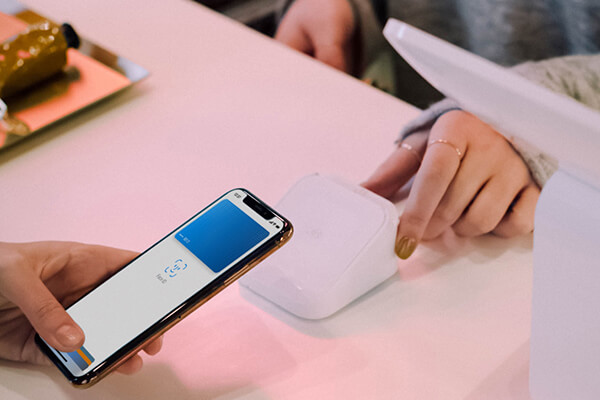
- Tap-to-redeeminteraction
- Faster checkout process
- Reduced physical contact
- Better compatibility with self-service terminals
In premium retail environments where service speed and seamless interaction matter, even small efficiency gains can scale into measurable operational improvements.
4. Integration Considerations
One of the most common concerns from retailers is system compatibility.
In most cases, POS hardware that supports contactless payment standards can technically read NFC cards. Implementation typically depends on:
- POS software configuration
- Encoding format alignment
- Backend gift card system setup
In environments where older POS terminals only support magnetic stripe or chip-based insertion (without NFC modules), hardware capability should be reviewed before deployment.
From a manufacturing perspective, we usually recommend confirming NFC protocol compatibility with the POS provider before finalizing chip selection. Planning alignment early helps avoid unnecessary adjustments later.
In most retail environments, existing contactless POS hardware does not require upgrading. Configuration alignment is usually sufficient.

5. Security and Fraud Reduction
Magnetic stripe cards are easier to clone or duplicate. NFC chips provide:
- Unique chip UID
- Encrypted data structures
- Controlled read/write access
For retailers concerned about gift card fraud or balance tampering, NFC provides higher security architecture. Reduced fraud exposure contributes to long-term ROI.
6. Brand Perception and Premium Positioning
For luxury retailers, tech brands, and experiential stores, packaging and card material matter.
NFC cards enable:
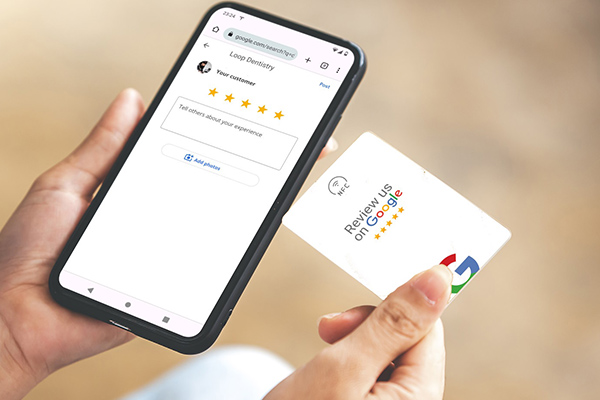
- Tap-to-website activation
- Interactive brand experiences
- Smart packaging integration
- Premium materials (FSC wood,BioPVC®, BioPaper®)
Many retailers also combine NFC technology with custom gift card printing, allowing unique designs, materials, and encoded interactions that reinforce brand identity.
7. When Does NFC Make Financial Sense?
NFC gift cards typically make sense for retailers who:
- Operate in premium or tech-forward segments
- Have high gift card circulation volume
- Want longer card lifespan
- Prioritize fraud reduction
- Seek differentiated customer experience
For small-scale, price-sensitive programs, magnetic stripe may still be sufficient.
The right decision depends on business model and long-term strategy. For retailers running large promotional campaigns or seasonal programs, bulk gift cards with NFC capability can also improve operational efficiency over time.
Planning the Right Upgrade Strategy
NFC gift cards are not simply a technology upgrade — they represent a structural shift in durability, interaction capability, and long-term operational efficiency.
For retailers evaluating the transition, the decision should be based on:
- Program volume and lifecycle
- Target customer segment
- Security considerations
- Infrastructure compatibility
Careful alignment between card specification and retail environment is essential to ensure the investment delivers measurable returns.
For teams currently reviewing their next gift card production cycle, early evaluation of chip type, material selection, and encoding requirements can significantly streamline implementation.
If you’re planning a new gift card program, testing NFC cards with your POS setup before launch is usually the safest approach.
Working with an experienced gift card manufacturer can also help streamline chip selection, encoding formats, and custom gift card production for large-scale or bulk gift card programs.
Quick Q&A:
Q1: What digital interactions can NFC gift cards do?
A1: A tap can open websites, link to apps, show offers, or enroll in loyalty programs—no app required.
Q2: Can NFC gift cards be customized for branding, shapes, or encoding specific data?
A2: Yes. Most gift card manufacturers support custom printing, special shapes, sustainable materials (such as wood or BioPVC®), and data encoding including URLs, IDs, or application-specific formats.
Q3:How to choose the right NFC chip for retail gift cards?
A3:Selection typically depends on memory size and application scenario. Evaluating your data structure and use case helps determine the most suitable chip type.
Q4: Are NFC gift cards suitable for high-temperature retail environments?
A4: Yes. The chip is sealed inside the card body and performs reliably in high-temperature retail environments.
Q5: Do NFC gift cards require POS hardware replacement?
A5: In most contactless-enabled retail environments, no hardware replacement is required. Alignment of configuration is typically sufficient.