

Compare RFID library labels, UHF asset labels, tamper-evident tags, on-metal RFID tags, and washable textile tags for school and university assets.
Introduction
Schools and universities manage many different types of assets.
These may include:
- library books
- laptops and tablets
- classroom electronics
- laboratory instruments
- furniture
- sports equipment
- maintenance tools
- uniforms and dormitory textiles
These assets do not all require the same RFID tag.
A thin label suitable for a library book may not work correctly on a metal server cabinet. A durable label for a laptop may not survive repeated laundry cycles. A long-range UHF tag may also be unnecessary for a close-range library circulation system.
For buyers, the key question is:
Which RFID tag is suitable for each school asset?
A practical starting point is:
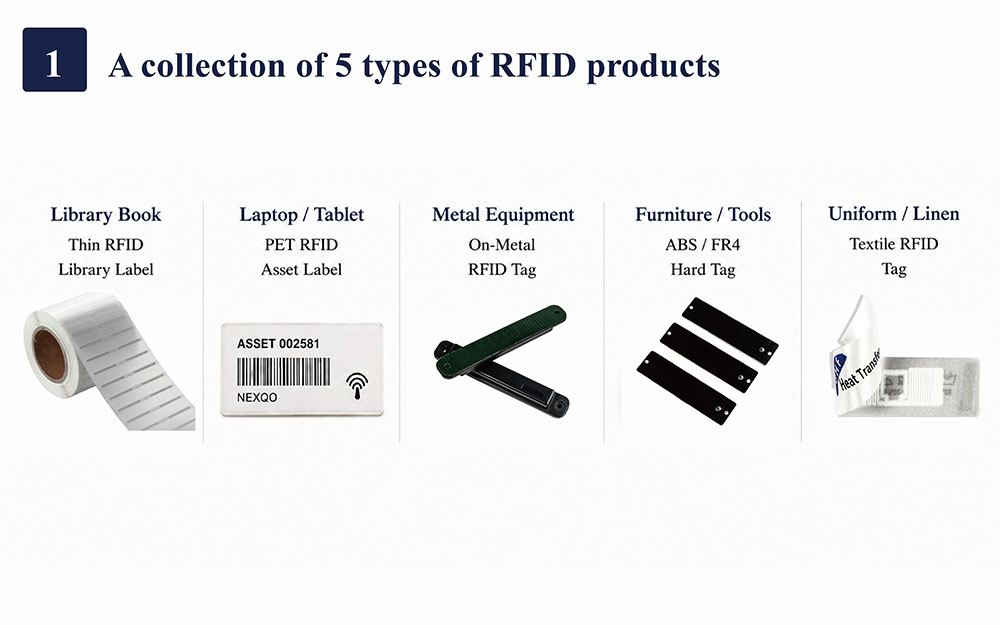
- Choose RFID library labelsfor books, journals, and printed materials.
- Choose durable RFID asset labelsfor laptops, tablets, projectors, and classroom electronics.
- Choose UHF RFID labels or hard tagswhen the project requires faster inventory of multiple assets.
- Choose on-metal RFID tagsfor metal cabinets, laboratory instruments, servers, and equipment.
- Choose washable textile RFID tagsfor uniforms, laboratory coats, towels, and dormitory linens.
The final tag should match the asset material, reader system, installation surface, required reading method, and expected service life.
Quick Product Selection Guide
| School Asset | Recommended RFID Product |
| Library books and journals | HF RFID library label |
| Archive files and teaching documents | Thin paper or PET RFID label |
| Laptops and tablets | Durable UHF RFID asset label |
| Projectors and printers | PET or tamper-evident RFID asset label |
| Metal laboratory equipment | On-metal RFID tag |
| Server cabinets and metal storage | On-metal RFID label or hard tag |
| Classroom furniture | UHF RFID label or hard tag |
| Sports equipment | Durable UHF RFID tag |
| Maintenance tools | UHF on-metal or hard RFID tag |
| Uniforms and laboratory coats | Washable textile RFID tag |
| Dormitory linens | Laundry RFID tag |
This table is a starting point.
The final choice should still be tested with the school’s actual readers, software environment, asset surfaces, and inventory process.

Which RFID Tags Are Used for School Library Books?
Library books normally require thin RFID labels that can be placed inside the book without affecting normal use.
Typical applications
- textbooks
- library books
- journals
- teaching materials
- archive files
- reference documents
Common product options
Depending on the existing library system, schools may use:
- paper RFID library labels
- PET RFID library labels
- printed or blank RFID labels
- HF library labels
- labels with printed barcodes or serial numbers
Many established library systems use HF RFID technology, so the required frequency and chip should be confirmed from the existing reader or library-system provider before ordering.
Paper vs PET Library Labels
Paper RFID labels are commonly considered when:
- the label is installed inside a book
- the environment is dry
- high-volume cost control is important
- the label does not require frequent surface cleaning
PET RFID labels may be more suitable when:
- better moisture resistance is required
- the tag will experience repeated handling
- the label is applied to frequently circulated materials
- greater surface durability is needed
The label size, antenna structure, adhesive, and chip must all match the book and library reader.
What Buyers Should Confirm for RFID Library Labels
Before ordering library labels, confirm:
- existing reader frequency
- required chip or protocol
- label dimensions
- installation position
- paper or PET surface
- permanent adhesive
- blank or pre-printed label
- barcode or serial-number requirement
- chip encoding requirement
- quantity
- sample testing process
NEXQO can supply the physical RFID labels and provide printing or encoding according to customer data.
The library circulation software, borrowing records, user accounts, and database management are provided by the school or its library-system supplier.
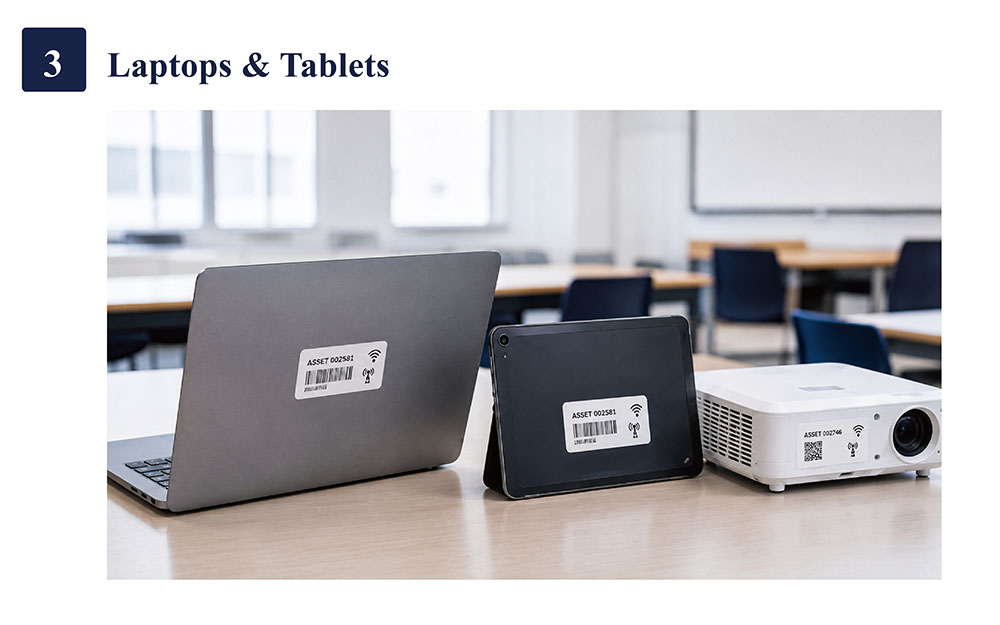
Which RFID Labels Are Suitable for Laptops and Tablets?
School IT equipment usually requires a more durable asset label than a library book.
Typical assets include:
- laptops
- tablets
- desktop computers
- monitors
- projectors
- printers
- charging devices
- classroom electronics
Durable PET RFID Asset Labels
PET RFID asset labels are commonly considered for IT equipment because they can provide:
- a thin product structure
- better surface durability than ordinary paper
- full-color or black-and-white printing
- serial numbers
- barcodes
- QR codes
- variable asset information
- RFID encoding
They are suitable when the device has a flat, non-metal installation area and the label needs to remain attached throughout the equipment’s service life.
Tamper-Evident RFID Labels
Tamper-evident RFID labels may be considered when the school wants to discourage label transfer between devices.
Depending on the construction, the label may:
- leave visible evidence after removal
- break when removal is attempted
- use a destructible surface
- include VOID or security features
The exact tamper-evident structure should be selected according to the device surface and the school’s identification requirements.
A tamper-evident label helps protect the physical asset identity, but it does not replace the asset records or authorization rules managed by the customer’s software.
Can Standard RFID Labels Be Used on Laptops?
Not always.
Some laptop surfaces contain metal or have internal components that may affect RFID performance.
Before choosing a standard label, buyers should confirm:
- where the tag will be installed
- whether the installation area is metal
- distance from batteries and electronic components
- available label space
- expected reading direction
- required read range
If the label is installed directly on a metal surface, an on-metal RFID label may be required.
For laptops and tablets, testing the finished label on the actual device model is more reliable than testing the label separately.
When Should Schools Choose UHF RFID Asset Tags?
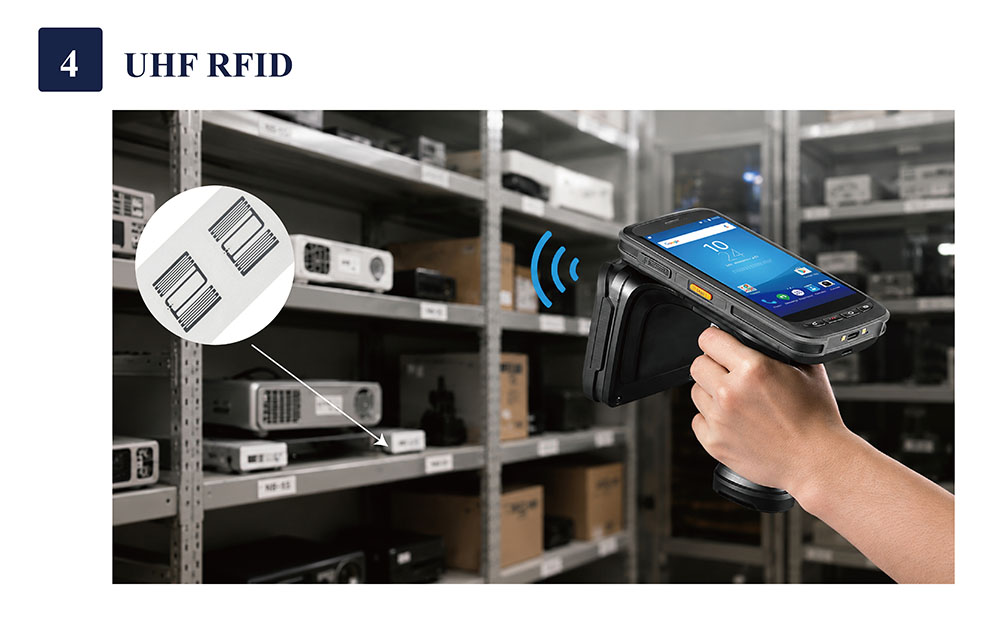
UHF RFID tags are commonly considered when schools or universities need to identify multiple assets during inventory checks.
Typical applications may include:
- classroom furniture
- IT equipment
- sports equipment
- maintenance tools
- storeroom inventory
- laboratory assets
- audiovisual equipment
- movable campus equipment
Available UHF Product Formats
Depending on the asset, NEXQO may supply:
- printable UHF RFID labels
- PET UHF asset labels
- tamper-evident UHF labels
- flexible on-metal UHF labels
- ABS hard tags
- FR4 RFID tags
- cable-tie RFID tags
- custom-shaped RFID tags
UHF is not automatically the best option for every school asset.
It is most relevant when the reader system, inventory method, and required reading distance are designed for UHF operation.
What Affects UHF RFID Reading Performance?
The chip alone does not determine the final performance.
Reading can also be affected by:
- tag antenna size
- asset material
- metal surfaces
- liquids
- tag orientation
- reader antenna position
- surrounding assets
- distance between tags
- installation location
For example, a UHF label that reads well on cardboard may perform very differently when attached to a metal cabinet or placed close to electronic components.
This is why tag selection should begin with the actual asset rather than only the desired reading distance.
Which RFID Tags Are Best for Metal School Equipment?
Standard RFID labels may have poor or unstable performance when attached directly to metal.
Schools should consider on-metal RFID products for:
- laboratory instruments
- server cabinets
- metal storage cabinets
- metal furniture
- maintenance tools
- industrial training equipment
- audiovisual equipment
- electrical enclosures
Flexible On-Metal RFID Labels
Flexible on-metal labels are often suitable when the project needs:
- a lower-profile product
- a printable surface
- barcode or serial-number printing
- attachment to a relatively flat metal surface
- variable asset information
ABS or FR4 Hard RFID Tags
Hard tags may be more suitable when the asset requires:
- stronger impact resistance
- outdoor or semi-outdoor use
- screw, rivet, cable-tie, or industrial adhesive installation
- longer service life
- more protection for the chip and antenna
Small On-Metal Tags
Compact on-metal tags may be considered for small tools or equipment with limited installation space.
However, reducing tag size may also affect the available antenna area and reading performance. Small tags should therefore be tested carefully on the actual asset.
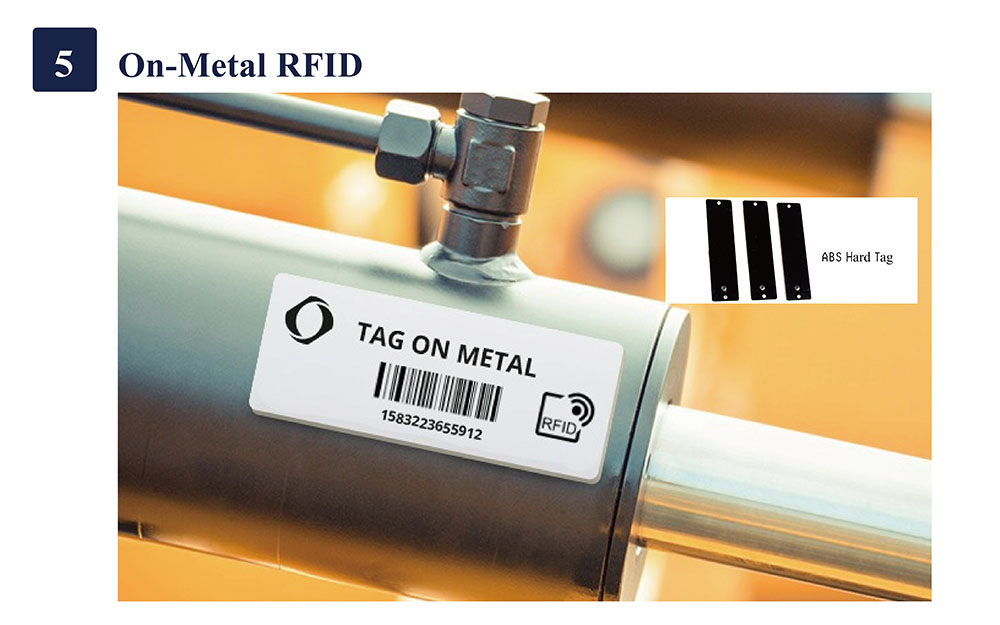
How Should On-Metal RFID Tags Be Installed?
Installation options may include:
- industrial adhesive
- foam adhesive
- screws
- rivets
- cable ties
- embedding inside a holder
The appropriate method depends on:
- equipment surface
- vibration
- cleaning
- temperature
- outdoor exposure
- expected product life
- whether the tag may need replacement
The installation method is part of the product design and should be confirmed before mass production.
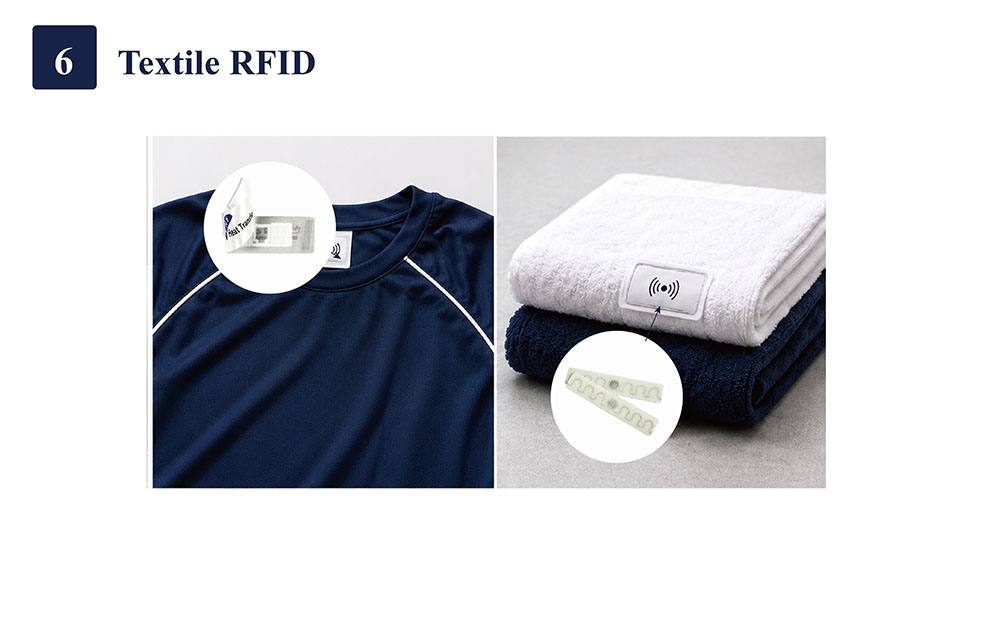
Which RFID Tags Are Suitable for School Textiles?
Some schools and universities also manage reusable textile assets.
Typical examples include:
- laboratory coats
- sports uniforms
- towels
- dormitory linens
- protective clothing
- reusable fabric equipment
These products require RFID tags designed for repeated washing rather than standard adhesive labels.
Common Textile RFID Formats
Depending on the application, products may include:
- washable fabric RFID tags
- heat-seal laundry tags
- sew-in RFID tags
- button-style laundry tags
- silicone laundry tags
The correct format depends on:
- washing temperature
- drying process
- chemical exposure
- ironing or pressing
- textile thickness
- sewing or heat-sealing method
- required read performance
A standard paper, PET, or ordinary asset label should not be used as a substitute for a tested laundry tag.
RFID Tag Products Compared
| RFID Product | Best For | Main Product Consideration |
| Paper library label | Books and documents | Thin structure and cost efficiency |
| PET library label | Frequently handled books | Better surface durability |
| PET asset label | Laptops and electronics | Durable printing and attachment |
| Tamper-evident RFID label | IT assets | Evidence of removal or transfer |
| Standard UHF label | Furniture and non-metal assets | Reader and surface compatibility |
| Flexible on-metal label | Flat metal equipment | Low profile and printable surface |
| ABS or FR4 hard tag | Tools and industrial equipment | Impact resistance and installation |
| Textile RFID tag | Uniforms and linens | Wash and heat resistance |
The school may need several tag types rather than one tag for every department.
Can One RFID Tag Be Used for Every School Asset?
Usually not.
Schools manage assets with very different:
- surfaces
- dimensions
- usage conditions
- lifespans
- reading requirements
- installation methods
Using the same tag on books, laptops, metal equipment, and uniforms may lead to:
- poor attachment
- unstable reading
- unnecessary product cost
- insufficient durability
- difficult installation
A better approach is to group assets by material and use condition, then choose a suitable product for each group.
What Buyers Should Confirm Before Requesting a Quotation
Asset Information
Provide:
- asset type
- asset material
- available tag area
- metal or non-metal surface
- indoor or outdoor use
- expected service life
- cleaning or washing requirements
RFID Requirements
Confirm:
- HF or UHF frequency
- required chip
- reader model
- expected reading method
- memory requirement
- encoding data
- unique ID or EPC requirement
Label or Tag Requirements
Confirm:
- dimensions
- material
- adhesive
- printable surface
- blank or pre-printed
- barcode
- QR code
- serial number
- asset name or department
- tamper-evident requirement
Project Information
Provide:
- quantity by tag type
- number of different designs
- variable-data file
- delivery schedule
- sample requirements
- final testing method
Clear asset information helps the manufacturer recommend a product based on the real installation condition rather than only the phrase “school asset tag.”
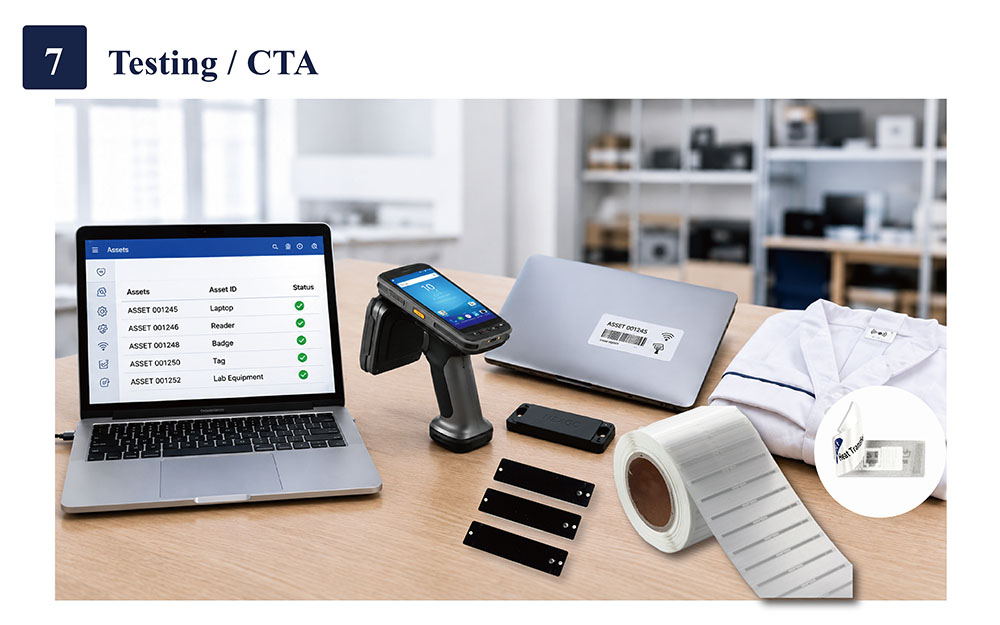
Why Finished-Asset Testing Matters
Testing the RFID tag in free air or on a sample board is not enough.
The finished tag should be tested after it is applied to the actual asset.
Testing should confirm:
- reader compatibility
- read performance
- installation position
- antenna orientation
- adhesive strength
- printed-data accuracy
- barcode or QR readability
- encoding accuracy
- durability under normal use
For on-metal tags, IT devices, and small assets, testing on the actual equipment model is especially important.
For textile tags, testing should include the actual washing and drying process.
What NEXQO Provides
NEXQO focuses on RFID hardware products.
Depending on the project, we can provide:
- HF RFID library labels
- UHF RFID asset labels
- printed PET asset labels
- tamper-evident RFID labels
- flexible on-metal RFID labels
- ABS and FR4 hard tags
- cable-tie RFID tags
- washable textile RFID tags
- custom printing
- barcode and QR-code printing
- serial numbering
- variable data
- chip encoding
- sample development
NEXQO does not provide school asset-management software, inventory databases, dashboards, or campus IT platforms.
These system functions are normally provided by the school, a software company, or an RFID system integrator.
Our role is to help ensure that the physical RFID tag matches the asset, reader, installation surface, and production requirements.
FAQ
What RFID tags are commonly used in school libraries?
Thin HF RFID library labels are commonly used for books, journals, and printed materials. Paper or PET surfaces may be selected depending on durability and handling requirements.
Which RFID tags are suitable for laptops and tablets?
Durable PET RFID asset labels, tamper-evident labels, or on-metal RFID labels may be suitable. The correct product depends on the device surface and installation position.
Can a normal UHF label be attached to metal equipment?
A standard UHF label may not perform reliably when attached directly to metal. An on-metal RFID tag or label should normally be considered and tested on the actual equipment.
Why do schools use UHF RFID tags for inventory?
UHF RFID may be selected when the school’s reader system is designed to identify multiple tagged assets during inventory checks. Final performance depends on tag type, asset material, reader setup, and installation.
Which RFID tag is best for school furniture?
Standard UHF labels or durable hard tags may be considered for non-metal furniture. Metal furniture may require an on-metal RFID product.
Can RFID tags include barcodes and QR codes?
Yes. Many RFID asset labels can also include barcodes, QR codes, serial numbers, department names, or other variable asset information.
Can one RFID tag be used across the entire campus?
Usually not. Books, electronic devices, metal equipment, furniture, and textiles have different tagging requirements and may need different products.
Does NEXQO provide school asset-tracking software?
No. NEXQO supplies RFID tags, printing, customization, encoding, and samples. Asset records, inventory reports, user permissions, and management software are provided by the customer or its system partner.
Conclusion
Choosing RFID tags for school asset tracking is mainly a product-matching decision.
- Library books require thin labels compatible with the library system.
- Laptops and tablets require durable asset labels and may need on-metal structures.
- Furniture and bulk inventory may use UHF labels or hard tags.
- Metal instruments require on-metal RFID tags.
- Uniforms and linens require washable textile tags.
The correct tag should match:
- asset material
- installation surface
- reader frequency
- required reading method
- product lifespan
- printing and encoding
- environmental conditions
For reliable results, the finished RFID tag should be tested on the actual school asset before mass production.
CTA
Looking for RFID tags for school or university assets?
NEXQO supplies RFID library labels, printable UHF asset labels, tamper-evident RFID labels, on-metal RFID tags, hard RFID tags, and washable textile tags.
Share your asset type, installation surface, reader frequency, chip requirement, tag dimensions, printing, encoding, quantity, and test conditions with our team. We can recommend suitable RFID tag products and prepare samples for evaluation before production.