.png)
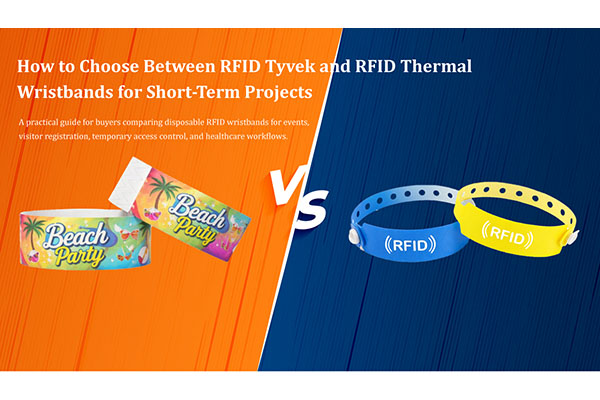
A practical guide for buyers comparing disposable RFID wristbands for events, visitor registration, temporary access control, and healthcare workflows.
Introduction
For short-term RFID projects, the wristband choice often looks simple at first.
Two of the most common options are RFID Tyvek wristbands and RFID thermal wristbands. Both are designed for temporary use. Both can support identification, access control, and registration. And both are widely used in projects where speed, simplicity, and cost matter.
But in actual deployment, the decision is usually not about which one is more advanced.
It is about something more practical:
How the wristbands will be printed, issued, and used in the real workflow.
For buyers planning events, visitor systems, healthcare identification, or temporary admission programs, that difference matters much more than the material name alone.

What RFID Tyvek and RFID Thermal Wristbands Have in Common
At a functional level, both options are built for short-duration RFID projects.
They are commonly used when teams need to:
- identify users quickly
- reduce manual checking
- improve entry or registration efficiency
- connect each wristband to a backend system
- issue credentials in large volumes
In many short-term projects, both types help simplify operations and speed up access compared with manual verification. This is one reason they are both widely used in temporary identification and admission programs.
When RFID Tyvek Wristbands Make More Sense
RFID Tyvek wristbands are usually the better fit when the project is based on fast distribution of pre-prepared wristbands.
This is common in:
- concerts
- exhibitions
- trade shows
- festivals
- pre-registered events
- promotional access programs
From a project workflow perspective, Tyvek works well when organizers want to prepare wristbands in advance and issue them quickly at the entrance.
Why buyers choose RFID Tyvek wristbands
- lightweight and easy to distribute
- cost-effective for larger volumes
- suitable for one-time use
- tamper-evident closure
- practical for fast admission control
- water-resistant enough for normal short-term use
For event-style projects, the main goal is often simple:
issue quickly, scan quickly, and keep people moving.
That is where RFID Tyvek wristbands usually perform well.
When RFID Thermal Wristbands Are the Better Option
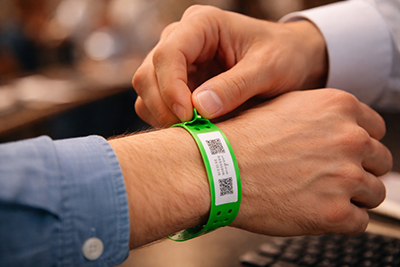
RFID thermal wristbands are more suitable when the workflow depends on printing and assigning each wristband on demand.
This is especially common when every wristband needs different information, such as:
- patient name
- ID number
- visitor details
- barcode or QR code
- registration data linked to the RFID chip
In these cases, the ability to print in real time is not just useful. It is part of the workflow itself.
Typical applications for RFID thermal wristbands
- hospitals
- clinics
- visitor registration
- temporary identification
- controlled entry systems
- check-in processes with variable data
For buyers managing real-time registration or patient identification, thermal wristbands usually make more operational sense than pre-printed Tyvek options.
RFID Tyvek vs RFID Thermal Wristbands: Quick Comparison
| Feature | RFID Tyvek Wristbands | RFID Thermal Wristbands |
| Best fit | Events, exhibitions, admissions | Hospitals, clinics, visitor registration |
| Main strength | Fast bulk issue | On-demand printing |
| Printing style | Usually pre-printed | Printed on site |
| Typical use | One-time event or entry control | One-time identification with variable data |
| Workflow focus | Speed at distribution | Speed at registration |
| Environment fit | General short-term use | Better for controlled indoor workflows |

What If the Project Needs Both Printing Flexibility and Better Durability?
Some projects do not fit neatly into either category.
For example, you may need:
- on-demand printing
- longer wearing time
- more handling
- better resistance to moisture
- a more stable material than standard thermal paper
In these cases, RFID synthetic thermal wristbands are often worth considering.
They keep the convenience of thermal printing while offering better durability and moisture resistance than standard thermal paper formats.
From what we see in real projects, this is often a practical option for:
- healthcare environments
- long visitor sessions
- mixed indoor/outdoor venues
- water-related or high-contact applications
How Buyers Usually Make the Final Decision
In actual sourcing projects, the choice usually comes down to workflow, not just material.
A few questions usually make the answer much clearer:
- Do you need to print each wristband on demand?
If yes, thermal wristbands are usually the better option.
- Will the wristbands be prepared before the event or project starts?
If yes, Tyvek often makes more sense.
- Is the project mainly about fast entry, or fast registration?
Fast entry usually favors Tyvek.
Fast registration usually favors thermal wristbands.
- Will the wristbands face moisture, friction, or longer wear time?
If yes, it may be worth evaluating synthetic thermal materials instead of standard thermal paper.
- Is cost the main priority, or is workflow flexibility more important?
Tyvek is often chosen for simple, cost-sensitive bulk admission.
Thermal is often chosen when operational flexibility matters more.
A Manufacturer’s Recommendation: Test the Workflow, Not Just the Material
From a manufacturing perspective, buyers often focus first on the wristband material.
But in real projects, the bigger issue is usually whether the wristband fits the actual issuance process.
A wristband that looks correct on paper may still create delays if it does not match the way the team prints, assigns, and distributes it.
This is why sample testing is often the fastest way to make the right decision.
For short-term RFID projects, testing can help confirm:
- print compatibility
- chip compatibility
- wearing comfort
- closure performance
- handling speed
- performance under actual use conditions
In many cases, the right choice becomes much clearer once the workflow is tested in practice.
FAQ
Can RFID Tyvek wristbands be printed on site?
They are usually pre-printed before use, so they are more suitable for projects where wristbands are prepared in advance.
Are RFID thermal wristbands waterproof?
Standard thermal wristbands are not fully waterproof. If better moisture resistance is needed, synthetic thermal materials are often a better option.
Which option is better for events?
For most pre-planned events and admission programs, RFID Tyvek wristbands are often the more practical choice because they support fast distribution.
Which option is better for hospitals or visitor registration?
RFID thermal wristbands are usually more suitable because they allow on-demand printing with variable user information.
Can both types use HF or UHF chips?
Yes. The chip choice depends on the system requirement, read distance, and reader compatibility.
Conclusion
RFID Tyvek and RFID thermal wristbands are both practical solutions for short-term projects, but they fit different workflows.
If the priority is fast bulk distribution for pre-prepared admission, RFID Tyvek wristbands are often the better choice.
If the priority is real-time printing and user-specific identification, RFID thermal wristbands usually make more sense.
And if the project needs both thermal printing and better durability, synthetic thermal wristbands may be the more balanced option.
For buyers, the best decision usually comes from matching the wristband to the real workflow — not just comparing materials on paper.
CTA
Not sure which RFID wristband fits your project best?
Share your workflow, printing requirements, chip preference, and use environment with NEXQO. We can recommend suitable wristband options and provide samples for testing before bulk production.